

The Airbnb Hiring Playbook: How to Stand Out in the 2026 Interview Loop
Airbnb's 2026 hiring guide: product tracks, Core Values interviews, AI founder mode, compensation, and how to apply before selective roles fill.
 jobstrack.io
Overview
Why This Guide Is Different Most Airbnb hiring guides tell you to study LeetCode and "be authentic." Both are necessary. Neither is sufficient. Airbnb's Core Values round is the single highest-leverage filter in the entire interview process: Glassdoor commenters describe it as the main elimination factor, and only 44% of candidates report a positive interview experience overall. This guide gives you explicit STAR-format prep for each of the 4 Core Values, decodes Brian Chesky's "AI founder mode" hiring filter, and breaks down the 2025 Summer Release tracks that competitors still treat as a monolith.
TL;DR: The 2026 Airbnb Hiring Strategy
- Apply within 24 to 48 hours of a posting going live: Airbnb's tight ~7,300-person headcount means roles fill from the first applicant cohort, with an average 29-day hiring cycle (Glassdoor, n=1,059 interviews)
- The Core Values round is the single biggest filter; only 44% of candidates report a positive interview experience overall
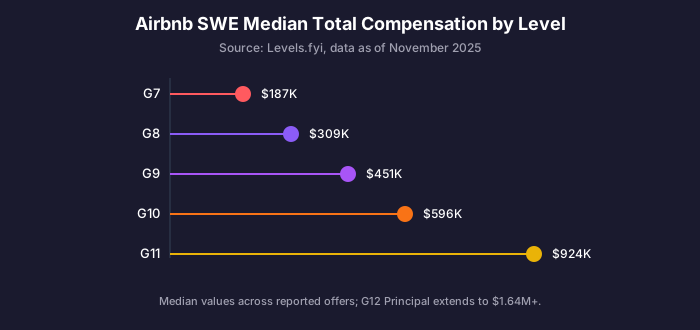
- SWE median total comp ranges from $187K (G7) to $924K (G11), with US median $548K (Levels.fyi, Nov 2025)
- Brian Chesky's "AI founder mode": Chesky is personally involved in ~50 hiring decisions and has stated publicly that pure people-managers and change-resistant workers won't survive Airbnb's AI era
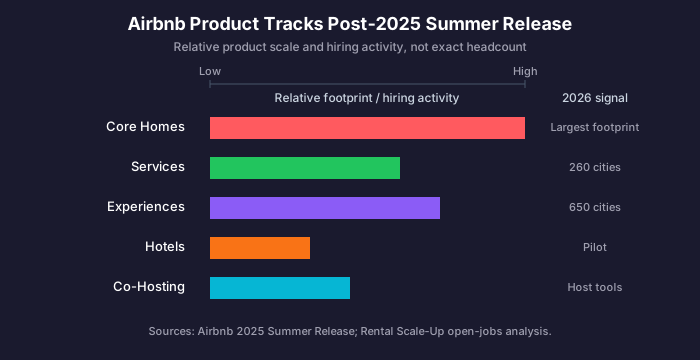
- Nearly half of Airbnb's 236 open roles reference AI; the 2025 Summer Release split Airbnb into distinct tracks (Core Homes / Services / Experiences / Hotels / Co-Hosting) with different hiring postures
Part I: What Airbnb Actually Is in 2026
Airbnb posted $2.8B Q4 2025 revenue at 12% YoY growth and $20B gross booking value up 16% YoY, marking its strongest quarter in over two years (Technology Magazine). That growth is no longer coming from one product surface. Airbnb today is a portfolio of distinct tracks, each with its own hiring posture and technical culture.
Headcount and Engineering Footprint
Airbnb employs approximately 7,300 people globally as of April 2026, up 7.2% year over year (Unify). Engineering sits around 650 in the core function, with broader technical staff (including data, ML, design engineering, and infrastructure) around 1,184. That's small for a company at this revenue scale.
The implication is simple. Compared to Google, Meta, or Uber, Airbnb's recruiting funnel is structurally tighter. Roles open. Roles fill. Roles close. So what happens if you apply in week three? You're often competing for a slot that's already shortlisted.
The 2025 Summer Release Reshaped the Product
In May 2025, Airbnb split its product surface into three tracks: Homes (the core marketplace), Services (260 cities), and Experiences (650 cities), plus a Hotels pilot (Airbnb Newsroom). That release matters for hiring because each track now has a different team culture, a different hiring posture, and different domain expectations.
Brian Chesky's Founder Mode Reorganization
Chesky has restructured Airbnb around a Steve Jobs-inspired flat hierarchy, personally involved in roughly 50 personnel decisions (Fortune, August 2025). The CEO is closer to hiring than at any peer company of comparable size. Ahead of the 2026 Summer Release, Airbnb has 236 open jobs, nearly half referencing AI in some form (Rental Scale-Up).
Airbnb also generated $93 billion in economic activity across the US in 2025 (Airbnb Newsroom, 2025). That scale, combined with a tight employee base, is the structural reason early application matters more here than at most peers.
Part II: Why Should You Apply Early at Airbnb?
Airbnb's hiring cycle averages 29 days across 1,059 reported interviews (Glassdoor), and Front-End Engineer roles average 27 days specifically. Airbnb's tight ~7,300-person headcount means roles fill faster than at high-volume employers, with most filling from the first 50 to 80 applicants. The early-applicant cohort is where careful review actually happens.
LinkedIn lags 18 to 48 hours behind direct career page postings (LinkedIn job posting delay analysis). By the time the role surfaces on aggregators, the first batch of applications has often already been screened. So what's the structural fix?
Based on jobstrack.io monitoring of Airbnb's career page across Q1 and Q2 2026, Airbnb roles often have only 30 to 60 day open windows before they're filled or pulled, and the candidates getting offers consistently come from the first applicant cohort. The window is short, and it closes quickly.
Three monitoring options work in practice. First, manual bookmarks plus a daily check of careers.airbnb.com. It works, but it's brittle. Second, Google Alerts on "site:careers.airbnb.com," which catches indexed pages but lags. Third, an automated career-page monitor like jobstrack.io that fires within minutes of a new posting. For the full system, see our guide to monitoring company career pages without checking daily and the broader first-mover advantage playbook.

jobstrack.io
Learn how to create job alerts for selective employers like Airbnb.
Part III: Which Airbnb Product Track Should You Target?
The 2025 Summer Release split Airbnb's product surface into distinct tracks with materially different hiring postures and team cultures (Airbnb Newsroom). Services launched in 260 cities and Experiences in 650 cities, both creating substantial new headcount needs alongside the mature Core Homes platform. Treating Airbnb as one company is the most common application mistake.
So which track should you target? The answer depends on your background and which kinds of problems energize you. Here's what each one looks like today.
Core Homes platform
Mature. The largest engineering footprint and the most senior bar. The focus is performance and reliability at marketplace scale: search, payments, Trust and Safety, host-guest matching, and the legacy stays product. If you've built search ranking, payments infrastructure, or marketplace systems at any meaningful scale, this is the natural fit.
Services
Launched May 2025 in 260 cities. This is the newest surface, and the hiring is fastest. It's a vetted-provider marketplace, which means product thinking around service-economy dynamics (supply onboarding, quality control, dynamic pricing) matters more than payments depth. Candidates with marketplace, gig-economy, or two-sided platform experience are valued disproportionately.
Experiences
Reimagined and relaunched May 2025 in 650 cities. "Airbnb Originals" anchor a curated content surface. The technical needs lean toward content curation, matching ML, and personalization. If you've worked on recommendation, ranking, or content moderation at consumer scale, the fit is strong.
Hotels pilot
Curated boutique hotels integrated into the main search, launched in NYC and select cities. Hospitality industry experience, supply operations, and inventory management backgrounds are valued. The team is small and the work is foundational.
Co-Hosting
Host-facing product surface expanded in 2025. The work resembles SaaS more than marketplace. Operations tooling, calendar management, and revenue optimization for hosts. SaaS PM or backend experience translates well.
Where the AI Roles Concentrate
Nearly half of Airbnb's 236 open job descriptions reference AI (Rental Scale-Up). The concentration spans Personalization, Trust and Safety, Payments, Customer Support, Listings/Host Tools, Marketplace, and Growth/Communications. AI-powered conversational search is rolling out across the product in 2026, which means ML and applied-research roles cluster on those teams.
Part IV: What Is "AI Founder Mode" and How Does It Reshape Hiring?
Brian Chesky has stated publicly that two types of people won't survive Airbnb's AI era: pure people-managers and workers resistant to change (Fortune, May 2026). Chesky is personally involved in ~50 personnel decisions and runs what he calls "AI founder mode," requiring leaders to be hands-on with implementation rather than delegating (Fortune, August 2025).
AI fluency is now a hiring filter on top of Core Values. Candidates who interview without demonstrating how they've personally used AI in their day-to-day work miss this signal. This isn't management theory. It's literal hiring criteria coming from the CEO.
The Origin: Founder Mode at Y Combinator
The "founder mode" framing traces to Chesky's 2024 Y Combinator speech, which argued that scaling companies fail when founders shift from operator to delegator too early. Chesky has publicly described AI as "the best thing that ever happened to Airbnb." That phrase signals where his attention sits.
What This Means for Candidates
Two practical implications. First, the behavioral bar for leadership roles has shifted. Pure people-managers (those whose value is coordination and 1:1s rather than direct contribution) are explicitly out of favor. Second, even individual contributors need to demonstrate hands-on AI usage.
How to Signal AI Fluency Authentically
Specifics beat buzzwords. Don't say "I leverage AI tools." (And don't use the word "leverage.") Say: "Last quarter I used Claude Code to refactor a legacy module, kept the AI-suggested changes in one branch and the human-written changes in another, then reconciled them in code review." Interviewers can tell the difference between rehearsed enthusiasm and genuine workflow integration.
The Behavioral Shift
Behavioral interviewers now evaluate three new dimensions on top of Core Values: adaptability under change, personal AI usage with concrete examples, and comfort with rapid iteration. Candidates who treat AI as a topic to perform on rather than a tool they actually use lose this round even when their technical work is strong.
Part V: How Does Airbnb's Interview Process Work?
Airbnb's process spans 3 to 5 weeks with an average 29-day end-to-end timeline (Glassdoor, n=1,059 interviews). The structure is typically 5 stages, with 1 to 2 dedicated Core Values rounds as a distinguishing feature. Glassdoor's interview difficulty sits at 3.15/5 overall, with Front-End Engineer rated among the hardest.
Stage 1: Recruiter Screen (30 minutes)
A logistical and motivation screen. The recruiter asks about your background, your interest in Airbnb (mission alignment will come up), your timeline, and compensation expectations. Come with a specific answer for which product track you want to work on and why. Generic "I love travel" answers stand out negatively.
Stage 2: Technical Screen
For backend SWE: a 60-minute live coding round on CoderPad, or in some cases an automated assessment on HackerRank or CodeSignal (Interview Query). Dynamic programming is unusually emphasized at Airbnb compared to peers. Practice DP patterns explicitly: 1D, 2D grid, interval, and tree DP.
For Front-End and Design Engineer roles: the technical screen requires implementing a reusable component using any framework, with reusability scored explicitly (Frontend Interview Handbook). Discuss component API design before writing code.
Stage 3: Virtual Onsite Loop (4-5 rounds, 45-60 minutes each)
Typically scheduled across one or two days. The composition varies by role and level.
Coding (1-2 rounds). Medium to hard, with DP problems common. Brute force first, then optimize, then test. Talk through edge cases.
System design (1 round, mid/senior+). Airbnb-flavored problems: design listings search, design Trust and Safety review pipelines, design a booking calendar engine. Distributed systems depth and consistency tradeoffs are scored.
Code review (Airbnb-specific round). A round that's distinct from coding. You're shown existing code and asked to review it. The signal here is craft sensibility: do you catch the actual problems, or do you focus on style?
Core Values (1-2 rounds). Covered in detail in Part VII.
Stage 4: Cross-Functional or Bar Raiser Round
A round with a hiring partner from another function (design, PM, or a senior IC outside the immediate team). The bar raiser model exists to calibrate decisions across teams. Expect open-ended questions about cross-discipline collaboration (Exponent).
So how is the final decision actually made? Not by any single interviewer. Airbnb uses a hiring committee that calibrates the entire loop before any offer is extended.
Stage 5: Hiring Committee Review
Final calibration. The committee reviews the full loop, normalizes scores, and decides. Turnaround from onsite to verbal offer is typically 5 to 10 business days (TechPrep).
Part VI: How Does Airbnb Compensation Actually Work?
SWE total compensation at Airbnb ranges from $183K (G7 entry) to $1.64M+ (G12 principal), with a US median of $548K and SF Bay Area median of $460K (Levels.fyi, data as of November 2025). Compensation is competitive with FAANG at every level and exceeds most public-company peers at Staff and above through aggressive equity refresh policy.
Geographic Premiums and Equity
Geographic bands matter. SF Bay Area median for SWE sits at $460K. New York comes in at $420K. Los Angeles at $240K. Other US metros vary by 15% to 25% off the SF band (Levels.fyi, November 2025). Engineering Manager comp tracks higher: M1 median $625K, M2 median $781K.
Airbnb is publicly traded (NASDAQ: ABNB), so RSUs vest on a standard four-year schedule with a one-year cliff and are immediately liquid on vest. This is a meaningful difference from private peers like Stripe, where liquidity depends on company events. See our Stripe hiring guide for the contrast.
What Moves in Negotiation
Refresh grants are common at Senior (G9) and above and are one of Airbnb's retention levers. Sign-on bonuses are used to close competing offers. Base salary is relatively inflexible within the geographic band. If you have a competing offer from a public-company peer, bring it. The recruiter has flexibility on equity and sign-on, less on base.
So how does this stack up against FAANG? The gap is smaller than most candidates assume.
Peer Comparison
Airbnb's SF median ($460K) roughly aligns with Google L5 and Meta E5. At Staff+ levels, refresh grant policy approaches the top of the public-company market, closer to Anthropic than to Meta in 2025-2026. If you're choosing between Airbnb and FAANG at equivalent levels, the gap is small in cash, and the differentiator is product fit and Core Values alignment.
Part VII: How Do You Pass Airbnb's Core Values Round?
Glassdoor commenters explicitly describe Airbnb's Core Values round as "the main elimination factor if you are not a culture fit" (Glassdoor). Only 44% of Airbnb interview candidates report a positive overall experience, in large part because technically strong candidates lose offers here. Why does this filter eliminate so many otherwise strong technical candidates?
The short answer: because most candidates prep technical rounds for weeks and Core Values for one afternoon. The asymmetry is the problem.
The 4 Core Values
Airbnb publishes four values that anchor 1 to 2 dedicated interview rounds. Each carries real weight in the hiring decision.
- Be a Host: service mindset, generosity, care for the user
- Champion the Mission: belief in belonging anywhere
- Embrace the Adventure: comfort with ambiguity and change
- Every Frame Matters: design and quality obsession across every touchpoint
How to Prep
Map 8 to 10 STAR-format stories to specific values, targeting roughly 2 stories per value. Each story should include a decision made under ambiguity, the action you took, and a concrete, measurable result. Interviewers probe for specificity, so rehearsed narratives that gloss over the messy middle don't survive follow-up questions.
The format isn't optional. Situation, task, action, result. But the actions and results need to be genuine, not optimized for the value name. A story that's clearly retrofitted to "Be a Host" comes across as performative. A story about a real time you went out of your way for a colleague, customer, or partner reads as authentic.
Common Failure Modes
Four patterns sink otherwise-strong candidates. First, performative enthusiasm without a specific personal anchor: candidates who recite Airbnb's mission rather than connect it to their own experience. Second, "Champion the Mission" stories that quote Airbnb's marketing rather than demonstrate genuine alignment. Third, "Every Frame Matters" answers that confuse perfectionism with quality obsession; the value is about caring across every touchpoint, not about being a perfectionist on one. Fourth, skipping the "Be a Host" story because the value feels softer; it's actually the most weighted in practice.
Part VIII: Is the Design Engineer Track Still the Underserved Hiring Opportunity?
Airbnb's Front-End / Design Engineer role is rated among the hardest interviews at the company on Glassdoor, with the technical screen requiring implementing a reusable component scored explicitly on reusability (Frontend Interview Handbook; Glassdoor FE). The bar is high, but so is the asymmetric opportunity.
Why This Track Is Underserved
Most Airbnb prep content focuses on backend SWE. The candidate pool for Design Engineer roles is smaller, but the role combines four hard skills: design sensibility, frontend systems depth, Core Values alignment, and design tooling familiarity (Figma, design tokens, component libraries). Well-prepared candidates have a real edge here.
What Airbnb Actually Evaluates
Three signals. First, component-system thinking rather than isolated UI implementation: can you reason about API design, theming, and accessibility as parallel concerns? Second, cross-discipline reasoning: can you talk about a design decision in both visual and engineering terms? Third, treating performance, accessibility, and visual quality as parallel concerns rather than a hierarchy where one wins.
Compensation Context
Design Engineer comp overlaps the G7-G10 range for backend SWE, often sitting at G8-G10. That's $309K to $596K median total comp, with refresh grants common at G9 and above. The role isn't a frontend specialist track; it's a design-and-engineering hybrid, and the comp reflects that.
For broader context on adjacent preparation, see our software engineer role guide.
Part IX: A Real-World Airbnb Application Walkthrough
Consider "Maya," a senior Design Engineer at a Series C consumer product company, targeting the Airbnb Core Homes Listings team in early 2026. Her process shows how track-specific application, early career-page submission, and explicit Core Values prep compound into a top-of-band offer.
- Week 1: A jobstrack.io alert fires Wednesday morning for a Senior Design Engineer role on Core Homes. Maya applies through Airbnb's career page directly three hours later, tailoring her resume to highlight component-system work and accessibility-first thinking.
- Week 2: Recruiter screen on Friday. Maya references the 2025 Summer Release Services rollout and specifically calls out the redesigned listings creation flow as a surface she'd want to evolve. The recruiter notes the specificity and moves her to the technical screen.
- Week 3: Technical screen, 60 minutes on CoderPad. She implements a reusable card component with explicit theming, accessibility props, and dark-mode handling. The interviewer notes that she discussed component API design tradeoffs before writing any code.
- Week 4: Virtual onsite, 5 rounds: 2 coding (including one DP problem on grid traversal), 1 frontend system design, 2 Core Values. One values prompt asks about advocating for design quality against engineering shortcuts; another asks about ambiguity.
- Week 5: Cross-functional with a design partner and a bar raiser. The conversation focuses on how she'd approach a redesign of the host onboarding flow without disrupting existing supply.
- Week 6: Offer at G9 with full Bay Area band.
What made the difference? Not luck. Not just technical chops.
What Actually Mattered
Five things mattered most:
- Track specificity: Maya targeted Core Homes Listings, not generic Airbnb.
- Early application timing: She applied through the career page within hours of the posting going live.
- Core Values preparation: Her stories demonstrated genuine alignment, not recitation.
- Component-system reasoning: She discussed API design, accessibility, theming, and dark mode before writing code.
- Behavioral specificity: Her STAR stories were honest and grounded in real tradeoffs.
None of these are tricks. They're the same things every Airbnb hiring manager will tell you matter, but most candidates skip them under interview pressure. See our first-mover advantage playbook for the broader framework and how to humanize your job applications for the application-level details.
Part X: What Should You Do If Airbnb Rejects You?
A 6 to 12 month cooldown is standard before reapplying to the same team at Airbnb, with Core Values rejections producing more "soft" rejections than technical rounds based on patterns reported across Glassdoor's 1,059 interview records. The structural advantage candidates underuse: track mobility. A rejection from Core Homes doesn't block applying to Services, Experiences, or Co-Hosting, because hiring decisions are made at the team and product-track level.
So what should you actually do with a rejection? Three things, in order:
- Ask for directional feedback: Recruiters won't share the full evaluation, but they can usually indicate which gap mattered: technical, Core Values, or cross-functional. That information shapes your next attempt.
- Re-prep Core Values stories explicitly if that's where the gap was: Map fresh stories, run mock behavioral interviews with someone who'll push on specificity, and rebuild the narrative inventory before the next attempt.
- Keep monitoring the career page: Airbnb posts roles continuously, and many open and fill within the same two-week window. See our first-mover advantage guide and how to monitor company career pages for the system.
Not every Airbnb posting reflects real headcount, either. Some are perpetual-pipeline roles. Our ghost jobs guide covers how to spot the difference. Don't let rejection define your next move. Let it inform your targeting.
Frequently Asked Questions
How long does Airbnb take to hire?
Average 29 days from first screen to offer across all roles (Glassdoor, n=1,059 interviews). Front-End Engineer roles average 27 days specifically. Senior and Staff roles can run 4 to 5 weeks; entry-level and intern processes often complete in 2 to 3 weeks.
How hard is it to get a job at Airbnb?
Glassdoor rates interview difficulty 3.15/5 overall, with Front-End Engineer rated among the hardest. Only 44% of candidates report a positive interview experience, largely due to the Core Values round, which Glassdoor commenters describe as the main elimination factor.
What are Airbnb's core values?
Four published values: Be a Host, Champion the Mission, Embrace the Adventure, and Every Frame Matters. These anchor 1 to 2 dedicated interview rounds that carry real weight in the hiring decision. Map 8 to 10 STAR-format stories to specific values for serious prep.
Is Airbnb still remote-friendly in 2026?
Yes. The "Live and Work Anywhere" policy remains active in 2026 (Airbnb Newsroom): employees can work from anywhere in their country with no pay change, plus up to 90 days per year abroad across 170+ countries. Brian Chesky's one rule: one pre-set week per month in the SF office.
How does Airbnb compensation compare to FAANG?
Median SWE total compensation at Airbnb in SF is $460K, roughly in line with Google L5 and Meta E5 (Levels.fyi, November 2025). At Staff+ (G10 and above), Airbnb's equity refresh grants approach the top of public-company market rates.
jobstrack.io
Track Airbnb career page openings the moment they go live.
References
Airbnb Official Resources
- Airbnb Careers: primary source for open roles; check directly rather than via aggregators
- Airbnb Newsroom: 2025 Summer Release: the Services + Experiences product split that reshaped 2026 hiring
- Life at Airbnb: culture, values, and Live and Work Anywhere policy details
Interview Preparation
- Levels.fyi: Airbnb Salaries: community-sourced compensation data by level and location (data updated November 2025)
- Glassdoor: Airbnb Interview Reviews: n=1,059 interview reports, with detailed Core Values round breakdowns
- Interview Query: Airbnb SWE Guide: coding question patterns and onsite structure
- Exponent: Airbnb SWE Interview Guide: system design and behavioral prep
- Frontend Interview Handbook: Airbnb: explicit Front-End and Design Engineer interview question patterns
- TechPrep: Airbnb Interview Process: end-to-end timeline and stage-by-stage breakdown
Context and Background
- Fortune: Brian Chesky on AI era, May 2026: the AI Founder Mode hiring filter quote
- Fortune: Chesky still in founder mode, August 2025: ~50-person personnel involvement and management approach
- Technology Magazine: Airbnb Q4 2025 results: $2.8B Q4 revenue, $20B GBV, AI strategy
- Rental Scale-Up: 2026 Summer Release predictions: the 236-open-jobs analysis with AI overlap
- Unify: Airbnb Headcount: ~7,300 employees as of April 2026
- Airbnb Newsroom: Live and Work Anywhere policy: the remote work framework still active in 2026
- The First-Mover Advantage: Applying Early to Tech Jobs: why applying within 24 to 48 hours matters at selective employers
- How to Get a Job at Stripe in 2026: comparison with another design- and writing-driven culture
- How to Get a Job at Uber in 2026: comparison with a marketplace-and-BU-segmented hiring approach
- San Francisco Bay Area Tech Job Scene 2026: regional context for Airbnb's primary engineering hub
Image Credits
- Airbnb mobile app photo by cottonbro studio on Pexels
- Airbnb office collaboration photo via The Forage
- Airbnb graphical interface photo by Oberon Copeland @veryinformed.com on Unsplash
- Airbnb Toronto office photo by Raysonho @ Open Grid Scheduler / Scalable Grid Engine, via Wikimedia Commons, CC0
More Articles
Your Next Role at AMD: A 2026 Guide to Teams, Pay, and Applications
Explore AMD engineering teams, software engineer compensation, software and hardware interviews, office locations, and how to prepare your application.
Sep 21, 2026
How to Get a Job at Figma in 2026: Salary, Interview Process, and Teams to Target
Figma's Q2 2026 revenue grew 48% as AI adoption accelerated. Learn which teams to target, compensation by level, and how its interview loop works.
Aug 21, 2026
How to Get a Job at Salesforce in 2026: Salary, Agentforce, and the Trailhead Path
Salesforce hiring in 2026: software engineer compensation, Agentforce and Data Cloud roles, the interview loop, Trailhead certifications, referrals, and how to apply early.
Jul 31, 2026