

How to Get a Job at Palantir in 2026: The Complete Guide
Palantir's selective hiring process, ODP interview, FDE role, compensation, and timing strategy for candidates targeting Gotham, Foundry, and AIP roles.
 jobstrack.io
Overview
There's a reason Palantir interviews are the subject of more Reddit threads, more confused Glassdoor reviews, and more candidate post-mortems than almost any company in tech. It's not that the process is unfair. It's that it tests something most candidates have never been tested on: not whether you can implement a solution, but whether you can define the problem correctly in the first place.
The Ontological Design Presentation (ODP) is the heart of that process, and it's nearly undocumented outside internal prep materials. Most guides describe it in a single sentence and move on. This guide doesn't.
Palantir posted its first full year of GAAP profitability in 2023, a milestone that took 20 years to reach, and its US commercial revenue grew over 70% year-over-year in 2024, driven largely by AIP (the AI Platform launched in 2023 that is now central to every enterprise sales motion) (Palantir Q4 2024 Earnings, 2025). The company is hiring again, and hiring selectively. If you want to be in that ~1-2% who gets through, you need to understand what Palantir is actually building, which division you're targeting, and how to approach an interview process that was deliberately designed to reject people who think like everyone else.
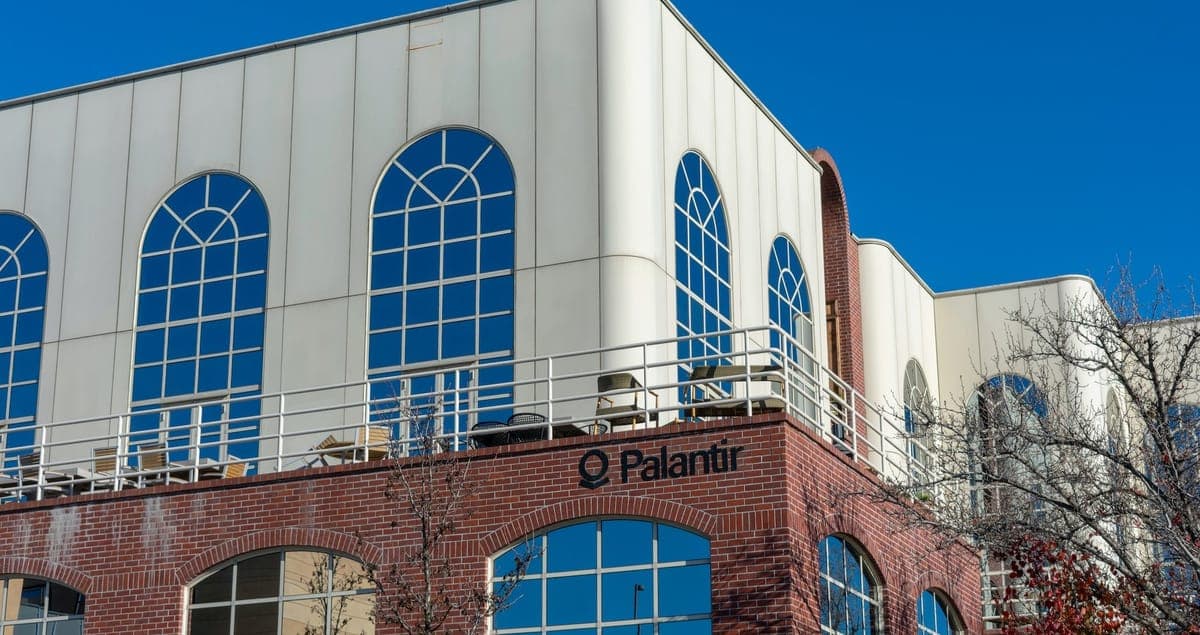
Image source: Built In / Shutterstock, "Inside Palantir: The Tech Giant Powering Government Intelligence."
Key Takeaways
- Palantir's estimated acceptance rate is ~1-2% across all roles, lower than Google or Meta, driven by the ODP and culture calibration rounds (Glassdoor Interview Data, 2025)
- The ODP (Ontological Design Presentation) is a 20-30 minute system design presentation evaluated on problem decomposition and ontology definition, not implementation. Most candidates fail by jumping to code
- Palantir achieved its first full year of GAAP profitability in 2023; US commercial revenue grew 70%+ YoY in 2024 on AIP adoption (Palantir Q4 2024 Earnings, 2025)
- Base salaries run deliberately below FAANG; total comp is competitive through equity. PLTR stock has appreciated approximately 4x since the 2020 IPO at $10
Part I: What Is Palantir Actually Building in 2026?
Palantir reached GAAP profitability in 2023 after 20 years, reported US commercial revenue growth of 70%+ year-over-year in Q4 2024, and employed approximately 3,800 people globally as of late 2024, making it one of the smallest headcount-to-revenue ratios in enterprise tech (Palantir Q4 2024 Earnings, 2025). Most candidates summarise Palantir as "a data analytics company" or "government surveillance software." Both descriptions are close enough to sound credible and wrong enough to doom an application.
Palantir builds operating systems for decisions. The products don't just process data; they define the ontological structure through which organisations understand and act on their data. That framing is not marketing language. It's the core engineering philosophy that drives every product and every hiring decision.
The Two Divisions You Must Know
Palantir operates as two structurally distinct businesses. Before you apply, you must decide which one you're targeting and why. Candidates who express general interest in "Palantir" without a clear division thesis fail the first recruiter screen at a higher rate than any other single reason.
Palantir Government (PGS) is the original business. Gotham, the platform used by the US Department of Defense, intelligence agencies, and allied governments, is the product. Work here involves classified data, military targeting, counter-terrorism operations, and infrastructure that runs on air-gapped networks. PGS roles require US citizenship. Many require an active security clearance at Secret or Top Secret/SCI level. The engineering problems are genuinely hard: real-time fusion of heterogeneous data from satellite imagery, SIGINT, HUMINT, and logistics systems. Compensation is competitive but not the highest in the market; mission alignment is table stakes.
Palantir Commercial (PCS) is the growth engine in 2026. Foundry (the enterprise data operations platform) and AIP (the AI Platform) are the products. PCS serves energy companies, hospitals, pharmaceutical manufacturers, financial institutions, and industrial firms, any organisation with large, messy, multi-source operational data that needs a governance and analytics layer. AIP, launched in 2023, is now the primary commercial growth driver: it gives enterprises the ability to connect LLMs to their internal Foundry data with guardrails, auditability, and ontological structure. US commercial revenue grew 70%+ YoY in 2024 because of AIP adoption. International hires are more accessible in PCS; citizenship requirements are only mandatory for roles that touch classified material.
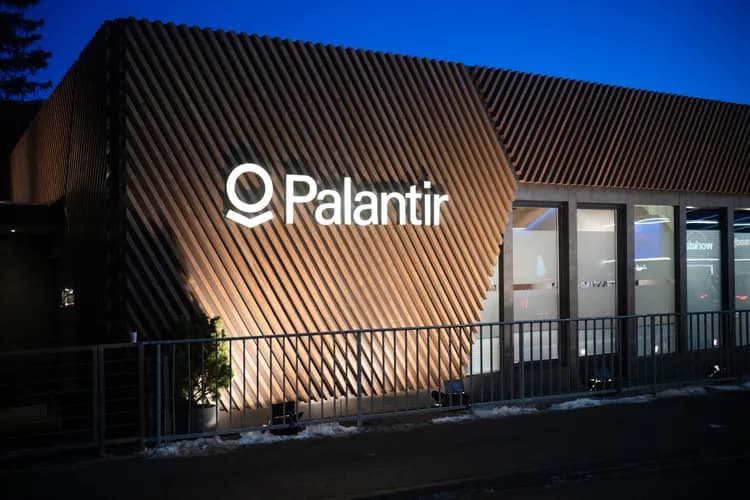
Image credit: Laurent Hou / Hans Lucas / AFP / Getty Images.
The Four Products
Understanding each product is a minimum bar for any interview conversation about Palantir.
Gotham is Palantir's government intelligence platform. Object-based: every data point is structured as an object with attributes and relationships. A person is an object. A location is an object. The relationship between them, including who was where, when, with what frequency, is navigable and auditable. Gotham was built to surface non-obvious connections in large, classified datasets. The engineering challenge is fusing heterogeneous sources at scale under strict access control.
Foundry is Palantir's enterprise data operations platform. Transforms raw data (from ERP systems, IoT sensors, financial feeds, clinical trials) into a structured ontology that can power dashboards, ML models, and operational decisions. Pipeline building, data lineage, and transformation logic live here. For data engineers, Foundry is the day-to-day technical environment on commercial deployments.
AIP (AI Platform) is the 2023-launched product now driving commercial growth. AIP connects foundation models (GPT-4o, Claude, Llama) to a customer's Foundry ontology, with full data governance, access controls, and auditability. The key differentiator from generic LLM APIs: AIP doesn't let the model hallucinate new facts. It grounds responses in the customer's actual operational data. AIP Boot Camps (intensive on-site workshops where Palantir engineers build custom AIP applications with the client team in 5 days) have become the primary enterprise sales motion in 2025.
Apollo is Palantir's continuous deployment infrastructure. Manages software rollouts across thousands of deployments, including environments with no internet access (classified government sites, forward military bases, offshore oil platforms). Apollo is less visible externally but critically important internally; it's the reason Palantir can operate a single unified codebase across wildly different operational environments.
Part II: Who Is Palantir Hiring in 2026?
Palantir's ~3,800 headcount is small for a company processing the data volumes it does, which means every hire is consequential and the bar is correspondingly high (Palantir Careers, 2025). Engineering roles are the most competitive. The Forward Deployed Engineer role is the most distinctive in the industry.
Palantir Base Salary Ranges, United States, 2026
Base salary only. Equity can represent 30-50% of total compensation at senior levels.
The Forward Deployed Engineer: Palantir's Most Distinctive Role
The FDE role is the most unusual engineering position in the enterprise software industry. Forward Deployed Engineers are software engineers who deploy on-site at clients, sometimes for weeks or months at a time, and build custom Foundry or AIP solutions directly in the client's environment. They are simultaneously engineers, product managers, and technical consultants.
What makes the FDE role structurally different from a solutions engineer or a consultant is the accountability model. An FDE doesn't hand off a design doc and leave; they write the production code. They own the deployment. If the system they built fails at 2am at a hospital or a logistics hub, the FDE is the person who gets paged. This model is why Palantir can operate at 3,800 employees what would take most enterprise software companies 15,000: the FDE combines the functions that other companies staff separately.
For candidates choosing between FDE and central software engineering roles: FDE is better for people who want direct client impact, variety of problem domains, and faster feedback loops. Central SWE is better for people who want to build the platform products (Gotham, Foundry, AIP) with deeper technical scope and less travel. Both are competitive; the ODP is required for both.
Other actively hired roles in 2026:
- Commercial Account Executive / Enterprise Account Executive (US commercial, AIP-focused)
- Data Scientist (Foundry deployments, model development on client data)
- Product Manager (AIP product, platform features)
- Deployment Strategist (PGS-focused; strategy and implementation for government programmes)
- Government Affairs / Policy (Washington DC concentration)
Part III: How Does the Palantir Hiring Process Work?
The Palantir interview process typically runs 6 to 10 weeks from application to offer, longer than most tech companies, and is designed to filter for high-agency thinkers rather than strong LeetCode performers (Glassdoor Interview Reviews, 2025). The acceptance rate across all roles is estimated at approximately 1-2%, which places it below Google and Meta in selectivity.
Stage 1: Recruiter Screen (30 Minutes)
The recruiter call tests two things before anything technical: which division you're targeting, and why. Candidates who say "I'm interested in Palantir broadly" fail this screen at a high rate. You need a specific answer: "I'm targeting PCS because I've been building data pipelines on regulated healthcare data and want to work on Foundry's transformation layer" is the kind of answer that advances.
The recruiter is also calibrating for mission alignment. Palantir has lost candidates before and during interviews because the candidate's motivation was "prestige" or "comp" rather than the actual mission (building software that affects consequential decisions at scale). This doesn't mean you need to be an idealist about government contracts. It means you need to have thought through where you stand on what the company does.
Stage 2: Technical Phone Screen (60-90 Minutes)
Standard LeetCode-medium coding problems in your language of choice. Data structures, algorithms, some system design discussion. This stage is the most conventional part of the process. Pass rate is lower than comparable screens at FAANG because Palantir doesn't move borderline candidates forward, but the format itself is familiar.
The technical screen for FDE roles often includes a short client scenario: "You've just arrived on-site at a manufacturing client. They have 14 separate data sources and no unified schema. Walk me through your first 48 hours." The answer isn't a data architecture diagram. It's a conversation about how you scope and prioritise before you write a line of code.
Stage 3: The ODP: Ontological Design Presentation (20-30 Minutes)
This is the defining round. The ODP is covered in depth in Part IV.
Stage 4: The Full Loop (4-5 Hours)
If you pass the ODP, you enter the full interview loop, typically conducted over a single day (virtual or on-site in Denver or New York for commercial; DC or Palo Alto for government). Rounds include:
- Technical depth round: Deeper system design or coding, specific to your target role
- Cross-functional round: An engineer may interview a PM candidate; a data scientist may interview an engineering candidate. Palantir wants everyone to understand the full technical context
- Culture / Values round: High-agency scenarios, handling ambiguity, working under pressure, not "tell me about a time you demonstrated leadership." More like: "You're six weeks into a deployment and the client's data is three months behind schedule. What do you do?"
- Senior leader calibration: A director or VP assessing fit and potential
Part IV: The ODP: Palantir's Unique Interview Explained
The Ontological Design Presentation is a 20-30 minute live presentation to a panel of Palantir engineers and/or FDEs in which you design a software system to solve a real-world problem. The problem is usually a fictional but realistic scenario: a hospital network that needs to track patient movement across facilities, a logistics company that needs to understand why deliveries are failing in specific regions, a defence agency that needs to fuse satellite and signals data for operational planning.
The critical insight most prep guides miss: the ODP is not a system design interview in the traditional sense. It doesn't test whether you can draw a microservices architecture or size a distributed cache. It tests whether you can define the ontology, meaning the objects, their attributes, and the relationships between them, that the system needs to represent before any code is written. Palantir's entire engineering philosophy is that the quality of the ontology determines the quality of everything built on top of it. A bad ontology means bad queries, bad pipelines, bad ML features, and bad operational decisions. The ODP is a direct test of whether you think this way naturally.
What the ODP Actually Evaluates
Palantir evaluators score the ODP on four dimensions:
1. Problem decomposition. Did you restate the problem in your own terms before designing anything? Did you ask clarifying questions about scope, access patterns, and stakeholder needs? Candidates who jump directly to drawing a diagram without establishing what problem they're solving fail this dimension.
2. Ontology quality. What objects did you define? What attributes did you give them? What relationships did you establish between objects? A strong ontology is minimal (no redundant entities), expressive (captures the relationships that matter for the operational decision), and extensible (can accommodate the data sources the client will add later).
3. Constraint handling. How did you respond when the interviewer introduced new constraints mid-presentation: a new data source, a missing field, or a latency requirement? The ODP is not static. Palantir wants to see how you reason under evolving requirements, not just how you present a polished design.
4. Reasoning process. Can you explain why you made the design choices you made? Not just "I defined Patient as an object" but "I defined Patient as an object rather than embedding patient data on the Encounter object because Patient-level attributes like consent and identity resolution need to be queryable independently of individual encounters."
The Most Common ODP Mistakes
Our analysis of candidate post-mortems on Glassdoor, Reddit r/cscareerquestions, and Blind from 2024-2025 identified five patterns in ODP failure reports:
- Jumping to implementation. The candidate starts drawing database schemas or API endpoints before defining what objects exist in the domain. Palantir evaluators call this "skipping the ontology." It signals that the candidate thinks in terms of code, not in terms of the domain being modelled.
- Over-engineering the technology layer. Spending 15 of 20 minutes describing Kafka pipelines, eventual consistency models, and horizontal scaling strategies while never clearly answering "what is the fundamental object model of this problem?" The technology choices matter far less than the ontology in the ODP context.
- Refusing to make decisions. "It depends" is not an acceptable answer unless followed by "and here's how I'd decide." Palantir values high-agency thinkers who can commit to a design direction under uncertainty, not candidates who hedge every choice.
- Treating it like a LeetCode problem. Sitting silently and thinking before presenting a polished answer. The ODP should be a collaborative conversation: narrate your thinking, invite the panel to push back, update your design when they introduce new information.
- Not knowing the product. Candidates who can't name Gotham, Foundry, or AIP, or who can't explain what an ontology is in Palantir's context, signal immediately that they haven't done the work.
How to Prepare for the ODP
Practice the following framework in the two weeks before your interview:
Step 1: State the decision you're serving. Do not stop at "build a data system." Instead, name the operational decision the system needs to support. This grounds every subsequent design choice.
Step 2: Identify the domain objects. What are the things that exist in this domain? Start with nouns: Patient, Facility, Encounter, Device, Clinician. Don't start with tables.
Step 3: Define attributes and relationships. What does each object know about itself? What relationships exist between objects, and what is the cardinality of those relationships?
Step 4: Map data sources to objects. Now, and only now, introduce the technical layer. Which existing data source populates which object? Where are the gaps? What's the identity resolution problem?
Step 5: Handle the constraint. When the interviewer introduces a new data source or a changed requirement, update your ontology explicitly and explain why the update doesn't break the rest of your design.
One practical preparation method: take a domain you know well (a previous job, a personal project) and force yourself to write an explicit ontology for it before you open a code editor. What are the objects? What are the relationships? What decisions does this ontology support? Doing this once or twice builds the instinct Palantir is testing.
Part V: What Do Role-Specific Palantir Interviews Look Like?
Palantir fills approximately 60% of its engineering headcount through SWE and FDE roles, with the remaining 40% split across PM, data science, and deployment-facing positions (Palantir Careers, 2025). Each role path has a distinct interview emphasis layered on top of the shared ODP requirement. Understanding these differences before you apply prevents the most common mismatch rejections.
Software Engineer (Central Platform)
Software engineers in central platform roles at Palantir (working on Gotham, Foundry, AIP, or Apollo) require strong backend engineering: Java, Typescript, or Python, with a focus on distributed systems, API design, and reliability at scale. The technical screen emphasises system design over algorithms at L4+. Expect questions about data consistency, access control patterns, and how to design APIs for an ontological data model.
For ML/AI engineers specifically, AIP is the primary hiring surface in 2026. Palantir is building the orchestration and governance layer that connects LLMs to enterprise ontologies. Relevant experience includes: LLM fine-tuning, retrieval-augmented generation (RAG), model evaluation frameworks, and AI safety/guardrails design. These roles are the fastest-growing in the company.
Forward Deployed Engineer
The FDE interview has a heavier client-scenario emphasis than central SWE. In addition to the ODP, expect questions like: "How do you handle a client who wants you to build something you think is the wrong solution?" or "What do you do when you're two weeks into a deployment and you discover the client's data model is fundamentally incompatible with what was sold?" These test your ability to navigate ambiguity and disagreement at client sites without escalating every decision to a manager.
Product Manager
Palantir PM interviews follow a standard product sense and execution format, but with a heavier emphasis on technical depth. PMs at Palantir are expected to understand the Foundry ontological data model at a working level, be able to read and critique engineering designs, and run AIP Boot Camps with clients. The ODP is still required for PM candidates; the panel wants to see how you think about problem structure, not just product strategy.
Part VI: What Does Palantir Pay in 2026?
Palantir base salaries run approximately 10-20% below Google and Meta equivalents at matched levels, a gap confirmed across employee reports on Levels.fyi and Glassdoor (Levels.fyi, 2026). This is intentional strategy, not a budget constraint. The thesis is that candidates who self-select on equity and mission are better fits than candidates who optimise for cash.
The equity story at Palantir is genuinely interesting in 2026 in a way it wasn't in 2021. PLTR went public via direct listing in September 2020 at approximately $10/share. The stock traded as high as $80 in 2024, driven by AIP adoption and the company's first GAAP-profitable year. Candidates who joined in 2021-2022 on RSU grants at $20-25/share have seen significant appreciation. New grants in 2026 are made at current market prices. The future appreciation story is unproven, but the trajectory has been positive.
Key compensation facts for 2026:
- No standard signing bonus. Palantir does not routinely offer signing bonuses. The negotiation lever is the initial RSU grant, not cash.
- 4-year vest, quarterly after year 1. Standard vesting with a 1-year cliff. RSUs vest into publicly traded PLTR stock, unlike pre-IPO companies, there's no liquidity question.
- Total compensation. At L4 SWE with a $175K base and a $100K annual RSU grant, total comp is approximately $275K, competitive with Google's equivalent level, though the base/equity mix is different.
- Government vs. commercial comp. PGS roles historically pay modestly less than PCS for equivalent levels, partially offset by the security clearance premium (cleared engineers command a market premium outside Palantir as well).
For negotiation, focus on the initial RSU grant. Competing offers from companies like Databricks, Snowflake, or Anduril are the most effective leverage. Palantir takes those comparisons seriously, particularly for exceptional candidates they've identified through the ODP.
Part VII: Why Do Most Palantir Candidates Fail?
Palantir's ~1-2% acceptance rate means the vast majority of candidates who make it past the resume screen still don't get an offer (Glassdoor Interview Data, 2025). Understanding the failure patterns is as valuable as prep. Most rejections cluster into five identifiable modes, and each one is avoidable with the right preparation.
Not knowing the product. Candidates who describe Palantir as "a big data company" or who can't explain the difference between Gotham, Foundry, and AIP in a two-minute conversation. This signals immediately that the candidate is applying to "Palantir" as a brand, not to a specific role on a specific product. Palantir is famously skeptical of candidates who want the logo.
Treating the ODP like a LeetCode problem. The single most common rejection cause for engineering candidates. Described in detail in Part IV.
Division ambiguity. Candidates who haven't thought through the PGS/PCS decision. The two divisions have genuinely different cultures, different security requirements, and different day-to-day experiences. Expressing interest in both simultaneously signals that you haven't done basic preparation.
Sounding like a consultant. Palantir values builder-thinkers: people who design and build systems themselves, not people who produce frameworks and presentations for others to execute. Answers heavy on "stakeholder alignment," "change management," and "organisational buy-in" without evidence of shipped systems raise flags, particularly for FDE candidates.
Failing the mission alignment calibration. This doesn't mean you need to endorse every government contract Palantir has ever signed. It means you've thought through your position on the company's work, including the controversial parts, and can articulate a coherent perspective. Candidates who deflect this topic or seem unprepared for it fail the culture round at higher rates than candidates who disagree but have a clear view.
Part VIII: How to Build a Palantir Application That Gets Read?
Palantir's small recruiting team reviews far fewer applications than FAANG companies at equivalent visibility, which means the signal quality of your resume matters more, and the right proof-of-work genuinely moves you from the screening pile to a recruiter call (Palantir Careers, 2025). The signals that advance here are different from Google or Meta, where company logos and scope of impact dominate.
Open source contributions to Palantir's public repositories. Palantir maintains active public repos: Blueprint (React UI component library), Conjure (RPC protocol framework), and others at github.com/palantir. A merged pull request is a direct signal of technical credibility and genuine product interest. No other prep guide emphasises this enough.
AIP Boot Camp participation. If your company has done an AIP Boot Camp, being the engineer who drove that process is a strong resume signal. If not, attend a public AIP workshop or build a personal project using the AIP API if available.
Domain experience in regulated industries. Palantir's work is concentrated in defence, intelligence, healthcare, energy, and financial services, all heavily regulated. Prior experience building data systems in any of these domains is a genuine differentiator, particularly for FDE candidates who will be deployed at clients in those sectors.
Public writing on data ontology or enterprise data architecture. A technical blog post explaining what an ontology is, why it matters for enterprise data systems, or how you approached a specific data modelling problem is the kind of proof-of-work that stands out in a Palantir application. It signals that you think about data the way Palantir thinks about data.
A clear division narrative on your resume. Your resume's summary should make clear which division you're targeting and why. Not "interested in data systems at scale". Use something like "five years of data engineering on clinical trial data pipelines, targeting Palantir's healthcare commercial deployments."
Part IX: How to Apply at the Right Time
Palantir posts roles on its own careers page at palantir.com/careers before they appear on LinkedIn or Indeed. The delay typically runs 24-72 hours. For a company that receives a high volume of applications and has an acceptance rate of ~1-2%, the application timing advantage is real: first-batch applicants are reviewed when the recruiter has full attention on the role, before the pipeline is saturated.
According to early application timing research, candidates who apply within the first 24-48 hours of a posting receive 2-3x more recruiter responses than those applying after aggregators index the role. Palantir's small recruiting team means this effect is even more pronounced than at larger companies.

jobstrack.io
Track Palantir's career page and apply the moment a role goes live before it reaches LinkedIn or Indeed.
Frequently Asked Questions
Is the Palantir ODP the same as a system design interview?
No. A system design interview tests your ability to design scalable technical infrastructure (databases, load balancers, caching layers). The ODP tests your ability to define the ontological model, meaning the objects, attributes, and relationships, that represent a real-world domain before any technical architecture is chosen. Most candidates who prepare with system design content fail the ODP because they skip directly to the technology layer without establishing the domain model.
Do I need a security clearance to work at Palantir?
Only for Palantir Government (PGS) roles that involve classified material. Many PGS roles require US citizenship as a prerequisite, with the clearance obtained after hire. Palantir Commercial (PCS) roles covering Foundry, AIP, and enterprise deployments have no citizenship or clearance requirement. For roles that do require clearance, Palantir will typically sponsor the clearance process for qualified candidates.
How does Palantir compensation compare to Google or Meta?
Base salaries at equivalent levels run approximately 10-20% below Google and Meta, deliberately, a gap confirmed in Levels.fyi reports for 2026 (Levels.fyi, 2026). The total compensation gap narrows significantly with RSU grants: PLTR stock is publicly traded (no liquidity risk unlike pre-IPO equity), and the stock has appreciated approximately 4x since the 2020 IPO. At staff and principal levels, Palantir total compensation is competitive with FAANG in practice.
Is the Forward Deployed Engineer role worth it versus a central SWE role?
For candidates who want direct client impact and varied problem domains, FDE is the stronger choice. FDEs ship production code in client environments, own deployments end-to-end, and see business outcomes faster than central platform engineers. The trade-off is travel (sometimes substantial on PGS deployments) and less time on foundational platform work. Compensation is comparable to central SWE at the same level.
How does Palantir compare to Databricks for a data engineering career?
Both are elite data infrastructure employers with genuine technical depth. Databricks is the stronger choice for open-source community impact (Spark, Delta Lake, MLflow) and pre-IPO equity upside. Palantir is the stronger choice for candidates who want to work on consequential operational problems where the system's output affects decisions with real-world stakes and who want the FDE deployment model. The interview processes are structurally different: Databricks rewards open-source knowledge; Palantir rewards ontological thinking.
The Verdict: Is Palantir Right for You in 2026?
Palantir's commercial business is in genuine acceleration in 2026. AIP adoption is driving the fastest US commercial revenue growth the company has ever posted. The products are technically serious. The FDE model is one of the most interesting engineering career paths in enterprise software. And the company is still small enough that individual contribution is visible and rewarded.
The cost is real: the acceptance rate is approximately 1-2%, the ODP requires a fundamentally different kind of preparation than any other tech interview, and the culture is deliberately high-pressure. Candidates who succeed here have usually done specific work to understand ontological thinking, know exactly which division and product they're targeting, and have something concrete to show, such as open-source contributions, domain expertise, or a clear track record of building systems that affected real decisions.
For other data infrastructure hiring guides, see our Databricks hiring guide and our data engineer career guide.
References
Company Financials and Strategy
- Palantir Q4 2024 Earnings: Source for 70%+ US commercial revenue growth YoY and GAAP profitability milestone.
- Palantir Careers: Official careers page; source for active roles and division structure.
Interview Process
- Glassdoor: Palantir Interview Reviews: Candidate-reported interview experiences; source for ODP difficulty ratings and process timeline data (2025).
Compensation
- Levels.fyi: Palantir Compensation: Crowd-sourced total compensation data for Palantir roles (2026).
- Glassdoor: Palantir Salaries: Employee-reported salary data (April 2026).
Open Source
- Palantir GitHub: Official Palantir open-source repositories including Blueprint, Conjure, and related projects.
Tools Mentioned
- jobstrack.io: Real-time career page monitoring for Palantir and other tech companies so applicants can apply within minutes of a role going live.
- First-Mover Advantage in Tech Hiring: Analysis of how early application timing affects interview response rates at selective employers like Palantir.
Image Credits
- Palantir at the World Economic Forum in Davos: Laurent Hou / Hans Lucas / AFP / Getty Images.
- Palantir office building exterior: Built In, "Inside Palantir: The Tech Giant Powering Government Intelligence". Image credited by Built In to Shutterstock.
More Articles
Your Next Role at AMD: A 2026 Guide to Teams, Pay, and Applications
Explore AMD engineering teams, software engineer compensation, software and hardware interviews, office locations, and how to prepare your application.
Sep 21, 2026
How to Get a Job at Figma in 2026: Salary, Interview Process, and Teams to Target
Figma's Q2 2026 revenue grew 48% as AI adoption accelerated. Learn which teams to target, compensation by level, and how its interview loop works.
Aug 21, 2026
How to Get a Job at Salesforce in 2026: Salary, Agentforce, and the Trailhead Path
Salesforce hiring in 2026: software engineer compensation, Agentforce and Data Cloud roles, the interview loop, Trailhead certifications, referrals, and how to apply early.
Jul 31, 2026