

Dallas-Fort Worth Tech Jobs 2026: Fortune 500 Engineering Hub
DFW added 37,230 tech jobs since 2022 and ranks eighth in CBRE's 2026 scorecard. Explore employers, salaries, living costs, and H-1B patterns.
 jobstrack.io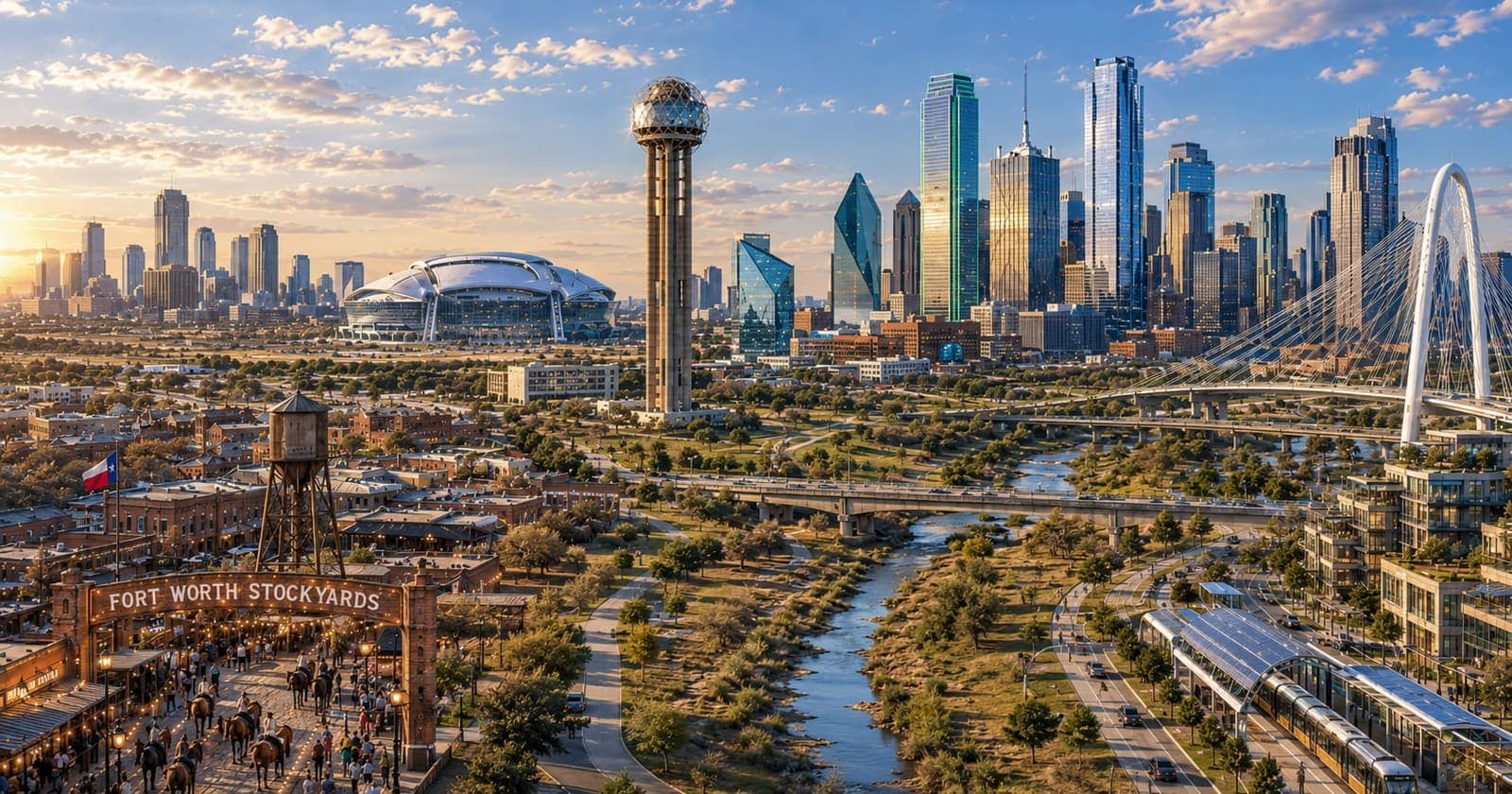
Drive north on the Dallas North Tollway past Plano and you will not see a single "we're hiring" banner or a rooftop logo you'd associate with Silicon Valley. What you will see is campus after campus: low glass buildings set back behind manicured lawns, employee shuttle stops, and parking structures built for tens of thousands of badges. JPMorgan Chase is back there. So is Capital One, Toyota's North American headquarters, and soon AT&T and Samsung Electronics America. Twenty minutes east in Richardson, State Farm runs a 2.2-million-square-foot regional hub. Out west in Westlake, Fidelity Investments occupies a 332-acre campus. It's the largest of its kind the company operates anywhere in the country.
None of this looks like a tech hub in the way that phrase usually gets used. There is no equivalent of Fulton Market or South Congress, no dense blocks of Series A startups pitching investors over coffee. What Dallas-Fort Worth has instead is something a lot of "best cities for tech" listicles miss entirely. It's a concentration of Fortune 500 finance, insurance, and telecom companies instead. They've quietly relocated or expanded entire engineering divisions into these suburbs, one multi-decade real estate commitment at a time.
That distinction matters more in August 2026 than it has in years. CBRE's newly published Scoring Tech Talent report ranks DFW eighth overall and reports 37,230 tech jobs added since 2022. A separate analysis of the report places DFW fifth by raw tech-workforce size after it passed Los Angeles. It is not a hardware story like Austin's, and it is not a venture capital story like San Francisco's. It is a corporate engineering and real estate story. That makes it a different kind of bet for anyone deciding where to build a career.
Here is what the Dallas-Fort Worth tech job market actually looks like in 2026.
Key Takeaways
- DFW is projected to add 11,013 net tech jobs in 2026, bringing the metro total to 388,026, the second-largest gain of any US metro behind only New York; tech now makes up 8.7% of the region's workforce with an estimated $89.4 billion in direct economic impact (CompTIA State of the Tech Workforce 2026, via Dallas Innovates, 2026)
- DFW added 37,230 tech jobs since 2022, a 19% increase. CBRE ranks it eighth on the 2026 Tech Talent Scorecard, while a separate analysis places it fifth by raw tech-workforce size after it passed Los Angeles (CBRE; CPA Practice Advisor, August 2026)
- DFW's tech employer base skews toward Fortune 500 corporate engineering rather than venture-backed startups: JPMorgan Chase (12,000+ at its Plano campus), State Farm (11,000+ in Richardson), Fidelity Investments (6,000+ at its 332-acre Westlake site), and Goldman Sachs (building toward 5,000+ at a new Victory Park campus) all run major engineering operations here (company disclosures via Axios Dallas, D Magazine, CoStar, 2026)
- Software Engineers in Dallas earn a median total comp of $135,000, with Data Engineers at the same $135,000 median, well below the $160,000 national figure, a signal that DFW's tech workforce skews toward mid-level corporate engineering rather than venture-funded product roles (Levels.fyi, 2026)
- Monitoring employer career pages directly can help candidates find openings before or soon after aggregators index them, improving the chance of joining an early review batch
How Big Is the Dallas-Fort Worth Tech Job Market in 2026?
CBRE's Scoring Tech Talent 2026 report, published in the final week of August, delivered the freshest headline in the DFW story. The metro added 37,230 tech jobs since 2022, roughly 19% growth, and ranks eighth on CBRE's composite Tech Talent Scorecard. A separate analysis of CBRE's workforce data places DFW fifth by raw tech-workforce size after it passed Los Angeles (CBRE; CPA Practice Advisor, 2026). The distinction matters: workforce size and the broader scorecard measure different things.
CompTIA's State of the Tech Workforce 2026 fills in the annual view. DFW is projected to add 11,013 net tech jobs this year, pushing the metro's total tech workforce to 388,026. That's second only to New York among US metros in absolute gain. Tech now accounts for 8.7% of the region's overall workforce, with an estimated $89.4 billion in direct economic impact. The median tech wage is $119,634, about 137% above the region's all-occupation median (Dallas Innovates coverage of CompTIA, 2026).
Is that enough to call Dallas-Fort Worth a top-tier tech market? Not quite, and the honest answer is worth sitting with. CBRE's broader Tech Talent Scorecard blends talent depth, market vitality, and attractiveness across more than a dozen metrics rather than raw headcount. On that measure, DFW still ranks 8th overall, trailing Austin (5th), Boston (7th), and Seattle (2nd). So this is a market rising fast on scale and growth rate, not yet a market with the density of specialized talent that Austin or Seattle have built over two decades. Both things are true at once: DFW is growing faster than almost anywhere else in the country, and it still has real ground to make up on raw talent depth.

Which Companies Are Actually Hiring in DFW Tech?
Here's the structural claim worth understanding before anything else. DFW's tech employer base is concentrated in Fortune 500 corporate technology divisions clustered in a handful of suburban campuses, mostly Plano, Richardson, Westlake, and Irving. It isn't a downtown startup district. If you're picturing a scene like Fulton Market or South Congress, recalibrate. The scene here is corporate real estate at scale.
JPMorgan Chase runs its largest non-New York operation from a Legacy West campus in Plano, with more than 12,000 employees on-site as of mid-2026. The bank's overall Texas headcount, roughly 31,500, now exceeds its New York headcount of 24,000 (Yahoo Finance, 2026). Worth noting for anyone weighing stability: JPMorgan announced the closure of a Plano call center affecting 244 roles, effective August 21, 2026 (CBS News Texas, 2026). Even a fast-growing corporate campus is not immune to periodic adjustments.
State Farm operates a 2.2-million-square-foot regional hub in Richardson, one of its largest regional operations in the country. More than 11,000 State Farm employees now work across the CityLine campus, according to a State Farm spokesperson cited by the Dallas Business Journal in October 2024 (Corgan, 2024). That's already well past the 8,000-to-10,000 range State Farm itself projected for the campus back in 2017, when it employed roughly 6,900 people there.
Fidelity Investments occupies a 332-acre campus in Westlake, its largest US regional site by footprint, with more than 6,000 employees (Fidelity Newsroom, 2026).
Goldman Sachs currently employs around 4,000 people across DFW. It's building an all-electric, 800,000-square-foot campus in Dallas's Victory Park, sized for 5,000-plus employees. The campus is expected to open in 2028 as the firm's second-largest US office after New York (CoStar, 2026).
Toyota Motor North America houses more than 4,000 employees at its Plano headquarters. Capital One runs one of its largest "people centers" from a seven-building, 1.5-million-square-foot Plano campus, though the company hasn't published a current headcount figure. Texas Instruments anchors chip design work along the Richardson Telecom Corridor, and McKesson runs its corporate headquarters from Irving.
Two live relocation stories prove this isn't a mature, static market. AT&T is consolidating nearly 6,000 workers from downtown Dallas into a new 54-acre Plano campus, targeted for mid-2028 (Axios Dallas, 2026). Samsung Electronics America is designating its existing Plano campus as its US headquarters by the end of 2026. The move affects 739 New Jersey roles, with most employees offered relocation packages, but it should not be read as 739 net-new jobs in Plano (D Magazine, 2026).
Career pages worth monitoring directly:
| Company | Career Page |
|---|---|
| JPMorgan Chase | careers.jpmorgan.com |
| State Farm | jobs.statefarm.com |
| Fidelity Investments | jobs.fidelity.com |
| Goldman Sachs | goldmansachs.com/careers |
| Capital One | capitalonecareers.com |
| Toyota North America | careers.toyota.com |
| AT&T | att.jobs |
| Samsung Electronics America | samsung.com/us/careers |
| Texas Instruments | careers.ti.com |
| McKesson | mckesson.com/careers |
What Can You Expect to Earn in DFW Tech in 2026?
Software Engineers in Dallas earn a median total compensation of $135,000 across all levels, with senior engineers at a median of $172,500, according to Levels.fyi (Levels.fyi, 2026). Built In reports a similar picture from employer-side data: an average base of $127,404 plus $7,833 in additional cash compensation, for an average total of $135,237. Its wider range runs $90,000 to $200,000 depending on company and level (Built In, 2026).
Data Engineers land at the same $135,000 median locally, which sits meaningfully below the $160,000 national median for the role (Levels.fyi, 2026). That gap is worth explaining rather than glossing over. DFW's tech workforce is disproportionately mid-level corporate engineering, banking, insurance, and enterprise IT, rather than venture-funded product engineering. That composition compresses the top of the compensation range, even while it keeps the middle unusually thick and stable. A ceiling does still exist: Intuit's Dallas-area engineers report an average total compensation around $305,000 (Levels.fyi, 2026). That figure likely reflects a mix weighted toward senior and staff levels, though, rather than a typical entry-level offer.
The corporate-employer thesis shows up directly in how pay gets structured, not just how much of it there is. At JPMorgan, Capital One, Fidelity, and State Farm, engineers work within defined job bands, scheduled annual review cycles, and predictable promotion ladders. Compare that to Austin, where equity grants at hardware and AI infrastructure companies create far wider variance between two engineers at the same nominal level. Neither structure is objectively better. They suit different risk appetites, and it's worth being honest with yourself about which one you actually want before you accept an offer.
For a broader view of the role, see our software engineer career guide and data engineer career guide.
Why Is DFW Becoming a Fortune 500 Engineering Hub?
It would be easy to describe Dallas-Fort Worth as "the enterprise alternative to Austin": a bigger, more corporate cousin filling the overflow when Austin gets too expensive or too crowded. That framing undersells what's actually happening here. DFW's growth isn't diffuse enterprise-software expansion. It is a specific, repeated pattern instead: large financial services, insurance, and telecom companies relocating or expanding entire engineering divisions into a small set of North Dallas suburbs. Those moves are backed by real estate commitments measured in decades, not funding rounds.
Look at the capital behind it. Dallas holds one of the highest concentrations of family-office capital in the country, a durable, patient form of private wealth. That's quite different from the institutional venture capital that concentrates in Austin's startup corridor. The two cities aren't running the same playbook with different logos. They're running different games entirely.
Think about JPMorgan's Plano build-out, Goldman Sachs's Victory Park campus, State Farm's Richardson hub, and AT&T's and Samsung's HQ relocations. None of those are the kind of commitments that unwind in a soft venture-funding year. A startup can freeze hiring or shut down when its Series C falls through. A bank that just broke ground on an 800,000-square-foot campus has already made a much longer bet. So has a telecom carrier consolidating 6,000 workers into a new headquarters; that kind of commitment plays out over a much longer horizon. That's the durability argument in plain terms. DFW's tech growth is tied to corporate real estate and headcount commitments, not to the funding cycle that governs a much larger share of Austin's job creation.
Is that a strictly better model for job seekers? Not automatically. It trades the upside of equity in a company that might 10x for something else: the predictability of a bank that's operated profitably for a century and plans to keep doing so. For candidates who've watched a startup's headcount evaporate overnight, that trade can look very appealing in 2026.
How Does DFW's Cost of Living Compare to Austin, SF, and NYC?
Both DFW and Austin sit in Texas, so both benefit from the state's lack of an income tax. That much the two metros share. Here's a rough, back-of-envelope illustration, not a sourced figure. A $150,000 earner relocating from a high-tax state like California or New York could plausibly avoid somewhere in the $8,000-to-$13,000-a-year range in state income tax alone, before rent savings even enter the picture. The exact number depends heavily on which state you're leaving and how it taxes income at that bracket. What they don't share is a clean "DFW is cheaper" story, and the actual 2026 numbers are more interesting than that.
SmartAsset's 2026 comfortable-living study is built on the MIT Living Wage Calculator and a 50/30/20 budgeting model. It puts the single-adult income needed to live comfortably at $96,970 in Dallas proper and $97,552 in Fort Worth and Arlington. Both figures sit a touch below Austin's $98,550 (SmartAsset via CultureMap Dallas; CultureMap Austin, 2026).
But the same study puts that figure at $109,242 for Plano, Frisco, and McKinney, the exact suburban corridor where JPMorgan, Capital One, Toyota, and AT&T's new campus actually sit. Put plainly: the city of Dallas is marginally cheaper to live comfortably in than Austin. But the suburb where you'd actually work, if you land one of these corporate engineering jobs, costs more than Austin does. That nuance rarely makes it into a "Texas is cheap" listicle.
Set against the coasts, the picture simplifies again. San Francisco requires $134,950 and New York City $158,954 for the same comfortable-living threshold, by the same SmartAsset methodology. That's roughly 39% and 64% above Dallas proper, respectively. Regional Price Parity data from the Bureau of Economic Analysis puts DFW's overall cost level close to the national average, not dramatically below it the way a decade-old "cheap Texas" stereotype might suggest (BEA Regional Price Parities, 2024).
Housing has softened recently. Dallas's median one-bedroom rent runs around $1,300 a month as of August 2026, down 8.1% year over year, according to Zumper (Zumper Dallas Rental Report, 2026). New apartment supply is one factor behind that movement, but rental conditions vary considerably between Dallas proper and the northern employment corridor.
Which DFW Employers Sponsor H-1B Candidates?
North Texas has a meaningful record of H-1B sponsorship, but the pattern varies by city and employer. USCIS Data Hub records summarized for January 2020 through September 2025 show 988 approvals for Texas Instruments and 952 for AT&T in Dallas. In Plano, Siemens recorded 1,001 and Ericsson 982. American Airlines recorded 1,582 in Fort Worth (USCIS H-1B Employer Data Hub; Dallas Express analysis, 2026).
The numbers point to several viable clusters: semiconductors and telecom in Dallas and Plano, consulting and enterprise technology services in Plano, and aviation in Fort Worth. Historical approvals do not guarantee that a company will sponsor a specific opening. Confirm the policy on the role itself and ask the recruiter about location, transfer, and sponsorship constraints early in the process.
Regional universities feed the pipeline directly: UT Dallas, UT Arlington, and SMU all supply OPT and CPT candidates to the corporate technology employers described above. Candidates should still treat sponsorship as role-specific rather than assuming a company-wide policy from historical approval data.
How Does DFW Compare to Austin for Tech Careers?
This is the question most searchers actually want answered, so here's the direct comparison, without pretending either city wins outright.
| Factor | DFW | Austin |
|---|---|---|
| Overall tech workforce size | 388,026, the larger base | Smaller overall base |
| Stability | Corporate stability, less exposed to venture funding cycles | More exposed to boom-bust VC cycles |
| Specialization | Banking, insurance, telecom engineering | Semiconductor, hardware, AI infrastructure |
| Raw compensation ceiling | Lower | Higher, driven by hardware and AI infrastructure roles |
| CBRE Tech Talent Scorecard rank | 8th | 5th |
| Cost of living, city proper | Marginally cheaper (SmartAsset 2026) | Marginally higher |
| Venture capital density | Lower | Higher |
| Startup equity upside | Limited at established employers | Founding-engineer and early-startup equity access |
The honest verdict: choose DFW if you want Fortune 500 corporate-tech stability in finance, insurance, or telecom. That means predictable bands, defined levels, and a company that has weathered multiple recessions already. Choose Austin instead if you want hardware and AI-infrastructure upside, or you're chasing startup equity and are comfortable with the variance that comes with it. Neither city is the objectively "correct" answer. They're optimized for different bets. For the full picture of what's driving Austin's side of that comparison, see our Austin tech job scene guide.
How to Apply for DFW Tech Jobs Before the Queue Builds
Whichever metro you target, timing still matters. Employer career pages are the primary source for their openings, while aggregators need time to discover and index those pages. Monitoring the source directly can help you join an early review batch, although applying early never guarantees an interview.
How to apply before the queue builds:
- Pick 5 to 10 target companies from the employer table above, not fifty. Depth beats breadth here.
- Bookmark each company's direct career page, not its LinkedIn company profile.
- Check career pages daily during Central Time business hours.
- Apply promptly when a well-matched role appears.
- Use jobstrack.io to monitor company career pages and receive alerts for matching roles.

jobstrack.io
Create alerts for roles at Dallas-Fort Worth tech companies.
For the full breakdown of why career-page timing beats aggregator timing, see our first-mover advantage guide and the underlying platform delay data.
Frequently Asked Questions
Is Dallas-Fort Worth really the "enterprise alternative" to Austin, or is that framing outdated?
It's more specific than that framing suggests. DFW isn't a generic "bigger, more corporate Austin." Its growth is concentrated in Fortune 500 finance, insurance, telecom, and enterprise engineering, with JPMorgan Chase, Goldman Sachs, State Farm, and Fidelity among the anchors. That is structurally different from Austin's venture-funded, semiconductor, and AI-infrastructure market. Both are Texas metros that share the state's lack of an income tax.
What is the average tech salary in Dallas-Fort Worth in 2026?
Software Engineers earn a median total compensation of $135,000 in Dallas, with senior engineers at a $172,500 median, according to Levels.fyi. Built In reports a similar $135,237 average total (base plus cash). Data Engineers median $135,000 as well, notably below the $160,000 national median, reflecting DFW's concentration in mid-level corporate engineering rather than venture-funded product roles.
Which companies are hiring the most in DFW tech right now?
JPMorgan Chase (12,000+ at its Plano campus), State Farm (11,000+ in Richardson), Fidelity Investments (6,000+ in Westlake), and Goldman Sachs (building toward 5,000+ at a new Dallas campus opening 2028) anchor the market. AT&T is relocating its headquarters to a new Plano campus by 2028. Samsung Electronics America is moving its US headquarters from New Jersey to Plano by the end of 2026.
How does DFW's cost of living compare to Austin, SF, and NYC?
Dallas proper and Fort Worth are both slightly cheaper for comfortable single-adult living than Austin, per SmartAsset's 2026 figures ($96,970 and $97,552 versus Austin's $98,550). But the Plano, Frisco, and McKinney corridor, where most of DFW's anchor tech employers actually sit, requires $109,242, more than Austin. Both DFW and Austin undercut San Francisco ($134,950) and New York City ($158,954) substantially, helped by Texas's lack of a state income tax.
Do DFW's major tech employers sponsor H-1B visas?
Yes, but sponsorship is role-specific. USCIS records summarized for January 2020 through September 2025 show approvals at Texas Instruments and AT&T in Dallas, Siemens and Ericsson in Plano, and American Airlines in Fort Worth. Historical approvals are a useful signal, not a promise that every current opening supports sponsorship.
What Does DFW Tech Actually Deliver for Engineers in 2026?
Start with the freshest data point, because it's the one that will still matter in a year. CBRE's Scoring Tech Talent 2026 report shows Dallas-Fort Worth added 37,230 tech jobs since 2022 and ranks eighth on its composite scorecard. A separate analysis places the metro fifth by raw tech-workforce size after it passed Los Angeles. That's not a fluke of one good report cycle. It's the visible output of a pattern that's been building for years. JPMorgan's Plano build-out, Goldman Sachs's Victory Park campus, State Farm's Richardson hub, and now AT&T's and Samsung's headquarters relocations are all part of it. These are real estate and headcount commitments made on long timelines, not venture-funding cycles that can reverse in a single down quarter.
That's a structurally different growth story than the one Austin or San Francisco tell. In a downturn, it's arguably a more defensible one, too. A bank that just broke ground on an 800,000-square-foot campus isn't walking away from that commitment because a funding round fell through somewhere else in the market. Whether that trade, corporate stability over startup upside, suits your career depends entirely on what you're optimizing for. DFW still trails Austin, Boston, and Seattle on CBRE's broader talent-depth scorecard. It isn't going to hand you founding-engineer equity or a semiconductor-scale pay ceiling, either. What it will hand you instead is a deep, still-growing bench of Fortune 500 engineering employers. They've been profitable for decades, and they've just made public, multi-year bets on Texas.
For the fuller comparison against Austin's Silicon and AI infrastructure story, see our Austin tech job scene guide. For role-specific guidance, see our software engineer career guide and data engineer career guide. And for the tactics that matter most once you've decided to apply, see our guide to beating the application queue.
References
DFW Tech Market and Employment
- CompTIA State of the Tech Workforce 2026, via Dallas Innovates: source for the 11,013 projected net new tech jobs, 388,026 total, 8.7% workforce share, and $89.4 billion economic impact figures (2026).
- CBRE: Scoring Tech Talent 2026: source for DFW's 37,230-job increase since 2022 and eighth-place composite Tech Talent Scorecard rank (2026).
- CPA Practice Advisor: Dallas-Fort Worth Passes L.A. to Take 5th in Tech Jobs in U.S.: analysis of CBRE's data that places DFW fifth by raw tech-workforce size.
Salaries and Compensation
- Levels.fyi: Software Engineer Salary in Dallas: median total compensation data for Dallas software engineers by level (2026).
- Levels.fyi: Data Engineer Salary in Greater Dallas Area: Dallas versus national Data Engineer median comparison (2026).
- Levels.fyi: Intuit Salaries: Dallas-area Intuit compensation data (2026).
- Built In: Software Engineer Salary in Dallas-Fort Worth, TX: employer-reported base, cash, and total compensation figures (2026).
Companies and Employers
- Axios Dallas: AT&T Moving Headquarters to Plano: AT&T's relocation from downtown Dallas to a new Plano campus.
- D Magazine: Samsung Electronics to Relocate U.S. HQ From New Jersey to Plano: Samsung's US headquarters move and estimated relocating headcount.
- CoStar: Goldman Sachs Begins Work on All-Electric Office Campus in Dallas: details on the Victory Park campus and current DFW headcount.
- Corgan: State Farm Still Believes in CityLine: State Farm spokesperson-confirmed employee count at the Richardson CityLine campus, citing Dallas Business Journal reporting from October 2024.
- Fidelity Newsroom: Fidelity Regional Site, Westlake TX: campus size and employee count at Fidelity's Westlake site.
- Yahoo Finance: How Texas Came to Rival New York as a Finance Hub: JPMorgan's Texas versus New York headcount comparison.
- CBS News Texas: JPMorgan Chase Plano Call Center Closure: reporting on the 244 affected roles and August 21, 2026 effective date.
Housing and Cost of Living
- SmartAsset: Salary Needed to Live Comfortably in U.S. Cities, 2026 Study: methodology and San Francisco/New York City comfortable-living figures.
- CultureMap Dallas: The Salary You Need to Live Comfortably in DFW: Dallas, Fort Worth, and Plano/Frisco/McKinney comfortable-living figures from the SmartAsset 2026 study.
- CultureMap Austin: The Salary You Need to Live Comfortably in Austin, 2026: Austin's comfortable-living figure from the same SmartAsset study.
- BEA: Regional Price Parities by State and Metro Area: cost-level comparison data for DFW relative to the national average.
- Zumper: Dallas, TX Rental Report: one-bedroom median rent and year-over-year change (2026).
Visa and Immigration
- USCIS: H-1B Employer Data Hub: primary source for historical employer approval data.
- Dallas Express: Who Are the Top H-1B Employers in North Texas?: city-level summary of North Texas employer approvals from the USCIS Data Hub.
Tools Mentioned
- jobstrack.io: career-page monitoring and role alerts for selected DFW tech companies.
- First-Mover Advantage in Tech Hiring: analysis of how early application timing affects interview response rates.
Image Credits
- Hero image: Dallas-Fort Worth cityscape illustration provided by jobstrack.io.
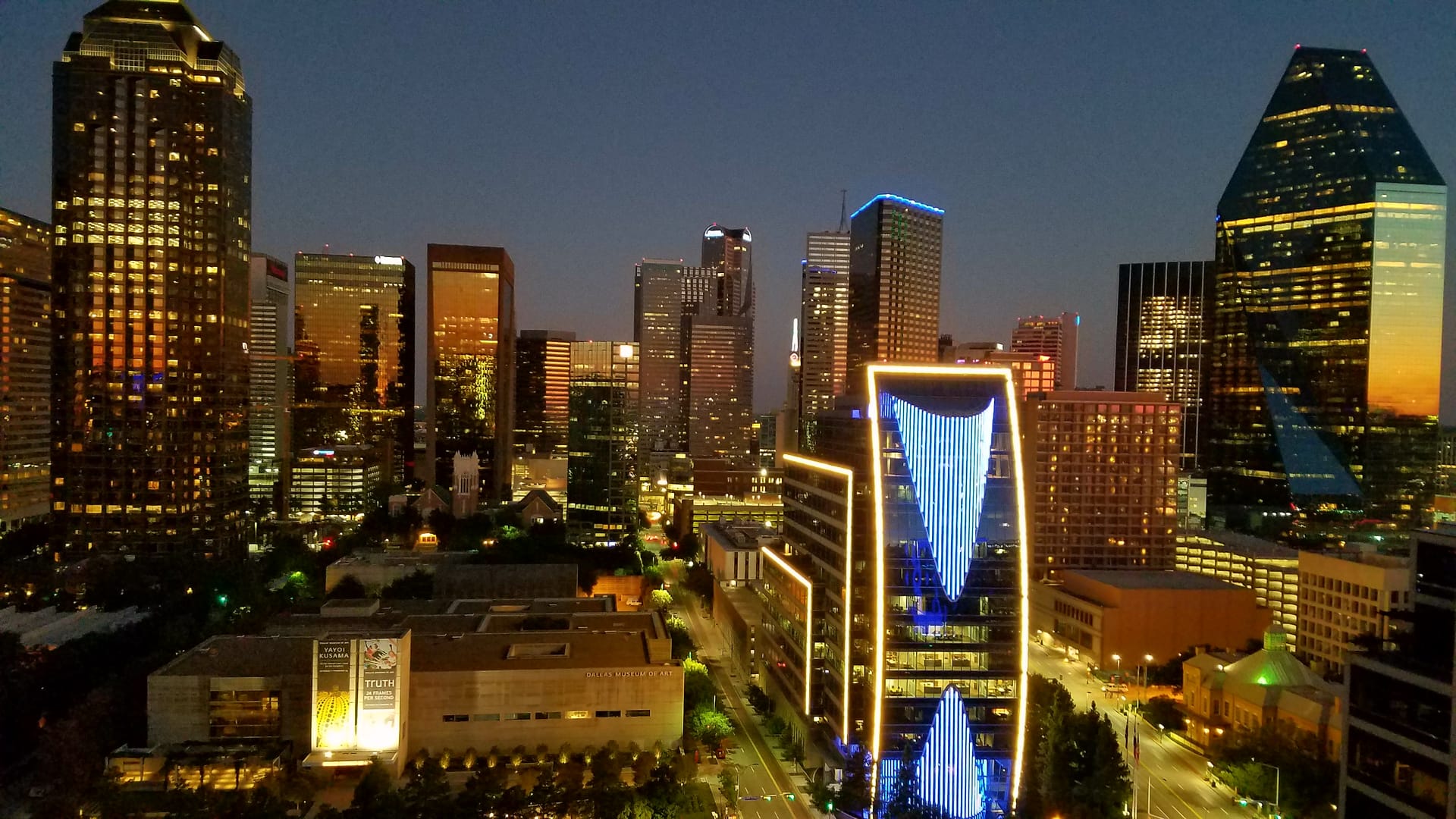
- Downtown Dallas skyline at night by Gabriel Tovar on Unsplash: in-article skyline image.
- Dallas Arts District and skyline by Gattacal on Wikimedia Commons: in-article image, licensed under CC BY-SA 4.0.
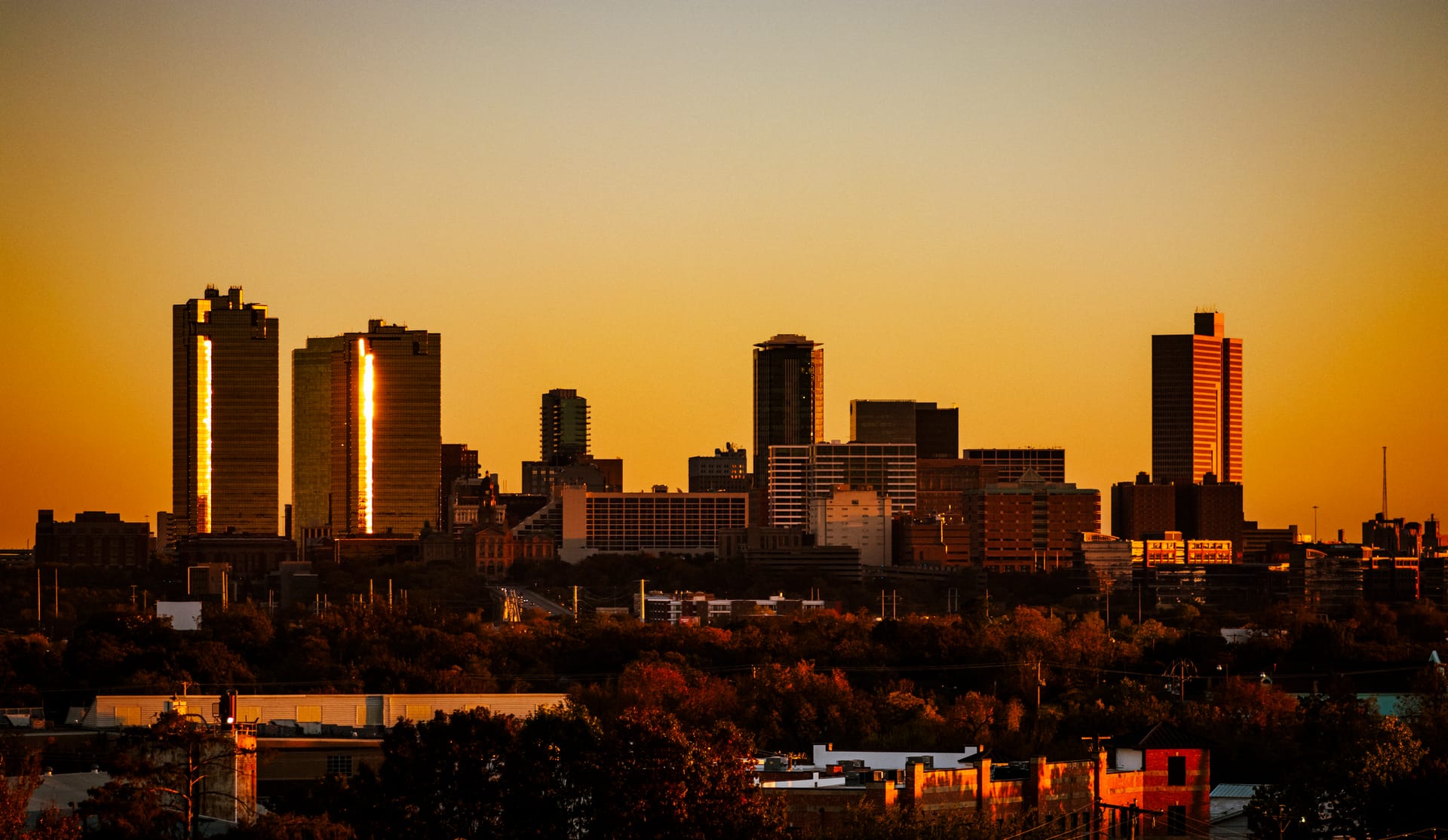
- Fort Worth skyline at sunset by Talena Reese on Pexels: in-article image.
More Articles
Paris Tech Jobs 2026: The AI Capital Hiring Playbook
Paris hosts Mistral, Anthropic, Meta FAIR, and a €93B Choose France 2026 commitment. This guide covers AI hiring, salaries, visas, and how to apply first.
Jul 26, 2026
Amsterdam Tech Jobs in 2026: The EMEA HQ Capital Playbook
Amsterdam hosts 25+ EMEA HQs of major US tech companies, where senior engineers earn €110K-€145K base. The 30% ruling, visa routes, and how to apply first.
Jun 8, 2026
Austin Tech Jobs 2026: The Invisible Market Playbook
Austin added 8,300 net new tech jobs in 2026. Most candidates can't see them. Here's the Invisible Market playbook for Silicon, AI infra, and speed.
May 29, 2026