

No Experience Resume Template: 2026 Examples and Tips
Entry-level roles get 400-600 applications. Here's the simple no-experience resume template that beats flashy ones, plus role-specific examples for first jobs.
 jobstrack.io
Entry-level positions receive 400 to 600 applications. Customer service and remote roles can exceed 1,000 in the first week (HiroCV, 2026; BestJobSearchApps, 2026). Your first resume doesn't need to look impressive. It needs to be easy to read.
The instinct most first-time job seekers have is reasonable but wrong: I don't have much experience, so I should make my resume look striking to compensate. The data says the opposite. Recruiters and ATS systems both prefer simple. A single-column resume parses successfully 94% of the time. Multi-column Canva templates lose 50% or more of their content when scanned (ResumeAdapter, 2025). The flashy template you picked to stand out is the same template that gets your content stripped before a human sees it.
Here's the no-experience resume template that actually works in 2026: a copy-paste structure you can drop into Google Docs, plus how to translate babysitting, school projects, certifications, and informal work into honest bullets, plus role-specific examples for fast food, retail, and admin (the three jobs most beginners are actually applying for).
Key Takeaways
- Entry-level positions receive 400-600 applications, and customer service or remote roles can exceed 1,000 in the first week (HiroCV, 2026; BestJobSearchApps, 2026). A simple one-page template beats a flashy multi-column one.
- Single-column resumes achieve a 94% ATS parse success rate. Tables, columns, and graphics cause 23% of parsing failures (ResumeAdapter, 2025). Most "ATS rejection" problems are template problems.
- Recruiters spend 17 to 46 seconds per resume, and the top third gets 80% of their attention (Enhancv, 2026). Put skills and certifications near the top.
- "No work experience" doesn't mean "no experience." Babysitting, cleaning, tutoring, school projects, volunteer work, and certifications all translate into resume bullets when framed with action + task + outcome.
- Avoid: photos, multi-column Canva designs, tables, graphics, "references available upon request," first-person paragraphs, and any kind of fake or exaggerated experience.
What Should a No-Experience Resume Look Like in 2026?
A beginner resume should be one page, one column, mostly black text on white, with no photo, no tables, no graphics, and standard headings. A single-column format achieves a 94% ATS parse success rate, while tables, columns, and image-heavy layouts cause 23% of parsing failures (ResumeAdapter, 2025; MIT CAPD, 2024). Simple isn't boring. Simple is functional.
The full anti-flashy checklist: one page, one column, conservative font (Calibri, Arial, or similar), reasonable margins, standard headings (Summary, Skills, Certifications, Experience, Education), and a PDF export unless the employer specifically asks for Word. No photo, especially for US applications. No tables. No icons or skill bars. No multi-column design that splits content across two parsing zones.
Here's the part that gets buried in most resume advice. The popular "75% of resumes get rejected by ATS" statistic is overblown. A 2025 study of US recruiters across more than 10 ATS platforms found that 92% don't configure auto-rejection rules based on content (ResumeAdapter, 2025). What actually rejects beginner resumes isn't keyword density. It's template choice. Multi-column Canva templates lose half their content when parsed. The fix isn't to obsess over keyword optimization (that's a separate topic). The fix is to pick a template the parser can read in the first place.
A simple single-column resume achieves a 94% ATS parse success rate, while multi-column and image-heavy templates lose 50% or more of their content during scanning (ResumeAdapter, 2025). The popular 75% ATS rejection statistic is overblown; 92% of recruiters surveyed do not configure content-based auto-rejection. Template choice is the actual issue, not keyword density.
What's the Best Resume Format When You Have No Work Experience?
Put your most useful evidence near the top. Recruiters spend 17 to 46 seconds on each resume, and the top third receives roughly 80% of their attention (Enhancv, 2026; Harvard Career Services, 2024). For a candidate with no formal work history, that means: name and contact, short summary, skills, certifications, then experience or projects, then education last.
The full section order:
- Name and contact information (name, city + state, phone, email, LinkedIn if relevant)
- Short summary or headline (2-3 lines, names role, key skills, and one credential or certification)
- Skills (8-10 listed, comma-separated or bulleted)
- Certifications (ServSafe, food handler, CPR, Google Career Certificates, anything earned)
- Experience, projects, or volunteering (informal work counts here)
- Education (school name, expected or actual graduation year, relevant coursework or activities optional)
- Optional (languages, availability, hobbies that directly support the role)
Why this order? Because the recruiter is scanning the top third for evidence that you can do the job. If "experience" goes first and yours is a short list of informal work, the scan ends before the recruiter sees your skills and certifications. Flipping the order puts your strongest evidence in the high-attention zone. Harvard's career services define a resume as "a concise summary of abilities, education, and experience" tailored to the position. The key word is concise, not complete.
Copy This No-Experience Resume Template
This template works for fast food, retail, admin, and most entry-level customer service roles. Paste it into Google Docs or Word, replace the bracketed placeholders, and save as PDF. It's intentionally plain so it parses cleanly through every major ATS, and the section order matches the attention pattern shown above.
[Full Name]
[City, State] | [Phone] | [Email] | [LinkedIn if relevant]

SUMMARY
Reliable and motivated entry-level candidate with experience in [customer
service / childcare / cleaning / school projects / food safety]. Strong
skills in communication, organization, time management, and following
instructions. [Certification name] certified and ready to contribute in
a fast-paced team environment.

SKILLS
- Customer service
- Communication
- Time management
- Organization
- Cleaning and sanitation
- Food safety basics
- Cash handling or basic math
- Teamwork

CERTIFICATIONS
[Certification name] - [Month Year]

EXPERIENCE / PROJECTS
Childcare Helper | [City, State] | [Year-Year]
- Supervised children during meals, homework, and activities.
- Communicated with parents about schedules, needs, and daily routines.
- Maintained a safe and organized environment.

Peer Tutoring Project | [City, State] | [Year-Year]
- Helped classmates review homework, study guides, and class notes.
- Explained assignments clearly and adapted explanations when needed.
- Maintained a regular study schedule and followed up before tests.

Animal Shelter Donation Project | [City, State] | [Year]
- Created 50 handmade cat toys for a local animal shelter.
- Organized materials and completed the project independently.
- Supported animal enrichment through a practical contribution.

EDUCATION
[School Name] - [Expected Graduation or Graduation Year]
Relevant coursework: [Optional]
Activities: [Optional]
A few notes. Replace anything in brackets with your real details. If you don't have certifications, delete that section. If you don't have informal experience that fits the examples, use what you actually have (tutoring, family business help, sports leadership, school clubs). Don't fabricate. For the application strategy that comes after the resume, see our best job boards guide.
What Should You Put on a Resume If You Have No Work Experience?
Babysitting, house cleaning, pet sitting, tutoring, school projects, club leadership, volunteer work, certifications, and personal projects all count if framed honestly (Harvard Career Services, 2024). The interviewer (and the ATS) cares about evidence of reliability, communication, organization, and willingness to learn. They don't care whether the experience came from a salaried job.
Here's how each common informal-experience category translates:
- Babysitting → "Supervised two children after school, managing meals, homework time, and safe activities."
- House cleaning → "Cleaned kitchens, bathrooms, and shared living spaces on a weekly schedule for [N] households."
- Pet sitting → "Cared for [N] dogs and cats over multiple weekends, handling feeding schedules and outdoor exercise."
- Tutoring → "Tutored [subject] for [N] middle school students over [time period], improving their understanding through weekly sessions."
- Family business help → "Assisted with [task] at family-owned [type of business], including [specific responsibility]."
- School projects → "Led a team of four on a research project on [topic], coordinating timeline, sources, and final presentation."
- Club responsibilities → "Organized weekly meetings for the [club name] of [N] members, including agenda and follow-ups."
- Sports leadership → "Captained the [sport] team for one season, coordinating practice schedules and team communication."
- Volunteer work → "Created 50 handmade cat toys for a local animal shelter, supporting animal enrichment."
- Certifications → "Completed [certification name] covering [topics]."
- Coursework → "Completed [course name] covering [topics relevant to the role]."
- Personal projects → "Built [project description] independently, learning [skill set]."
Notice the pattern. Each line names a specific action, a measurable detail (number, frequency, or duration), and the skill or outcome demonstrated. That's the action + task + outcome formula, which is what the next section covers in depth. For more on how informal experience plugs into a broader application strategy, see our best job boards guide for 2026.
Beginner Resume Bullet Formulas (With Examples)
Use one of five formulas. Each compresses informal experience into the format recruiters expect to see, and each builds in the action verb that ATS parsers and human readers both look for first (Harvard Career Services, 2024; MIT CAPD, 2024). No first-person ("I") statements. Numbers when honest. Specifics over adjectives.
1. Action + task + outcome. "Created 50 handmade cat toys for a local animal shelter to support animal enrichment."
2. Action + responsibility + skill demonstrated. "Supervised two children after school, managing meals, homework time, and safe activities."
3. Action + tool or process + result. "Organized cleaning supplies and completed weekly household cleaning tasks on schedule for six months."
4. Action + customer or team context + quality. "Communicated clearly with parents about schedules, routines, and special instructions."
5. Certification + relevance to role. "Completed ServSafe Food Handler certification covering sanitation, food safety, and safe handling practices."
A side-by-side example shows how much the formula matters. Weak: "Helped take care of kids." That's not a bullet. It's a phrase. Strong: "Supervised two children after school, managing meals, homework time, and safe activities, while communicating daily with parents about schedules." Same underlying activity. Completely different signal. The second version uses an action verb (supervised), names a specific number (two children), describes the actual work (meals, homework, safe activities), and adds the communication detail that demonstrates a transferable skill. None of that is invented. It just makes visible the work the candidate was already doing.
The "weak" version is what most first-time job seekers submit, because it sounds humble and accurate. The "strong" version is what the same candidate could have written with five extra minutes of thought. The bar isn't fabrication. It's specificity.
Resume Examples for First Jobs: Fast Food, Retail, and Admin
The three jobs most beginners apply for need slightly different framing. Fast food emphasizes food safety, cleanliness, teamwork, and reliability. Retail emphasizes communication, organization, and customer service. Admin emphasizes attention to detail, written communication, and digital tool comfort. Each role's job description repeats certain keywords, and your summary plus skills sections should reflect them honestly.
Fast food (summary + skills).
SUMMARY
Entry-level food service candidate with ServSafe Food Handler
certification, strong attention to cleanliness, and experience completing
tasks in fast-paced home and school environments. Reliable, organized,
and comfortable following detailed instructions.

SKILLS
Food safety basics, cleaning and sanitation, teamwork, communication,
time management, basic math, reliability, fast-paced environment

CERTIFICATIONS
ServSafe Food Handler Certification - 2026
Retail (summary + skills).
SUMMARY
Motivated entry-level candidate with strong communication, organization,
and problem-solving skills. Experienced in helping others, managing tasks
independently, and staying reliable under routine responsibilities.

SKILLS
Customer service, communication, organization, attention to detail, basic
math, teamwork, punctuality, POS/cash register basics, stocking
Admin or customer support (summary + skills).
SUMMARY
Organized entry-level candidate with strong written communication,
attention to detail, and comfort using digital tools. Able to follow
processes, manage information carefully, and communicate clearly.

SKILLS
Email communication, organization, data entry basics, scheduling,
document formatting, problem solving, customer support mindset,
Google Workspace, Microsoft Office basics
Mix and match where the role calls for it. A grocery store cashier is retail with light food handling. A receptionist is admin with customer service. The summary and skills sections are the part you tune per application. The experience and education sections stay the same.
Are Canva Resume Templates Good for Beginners?
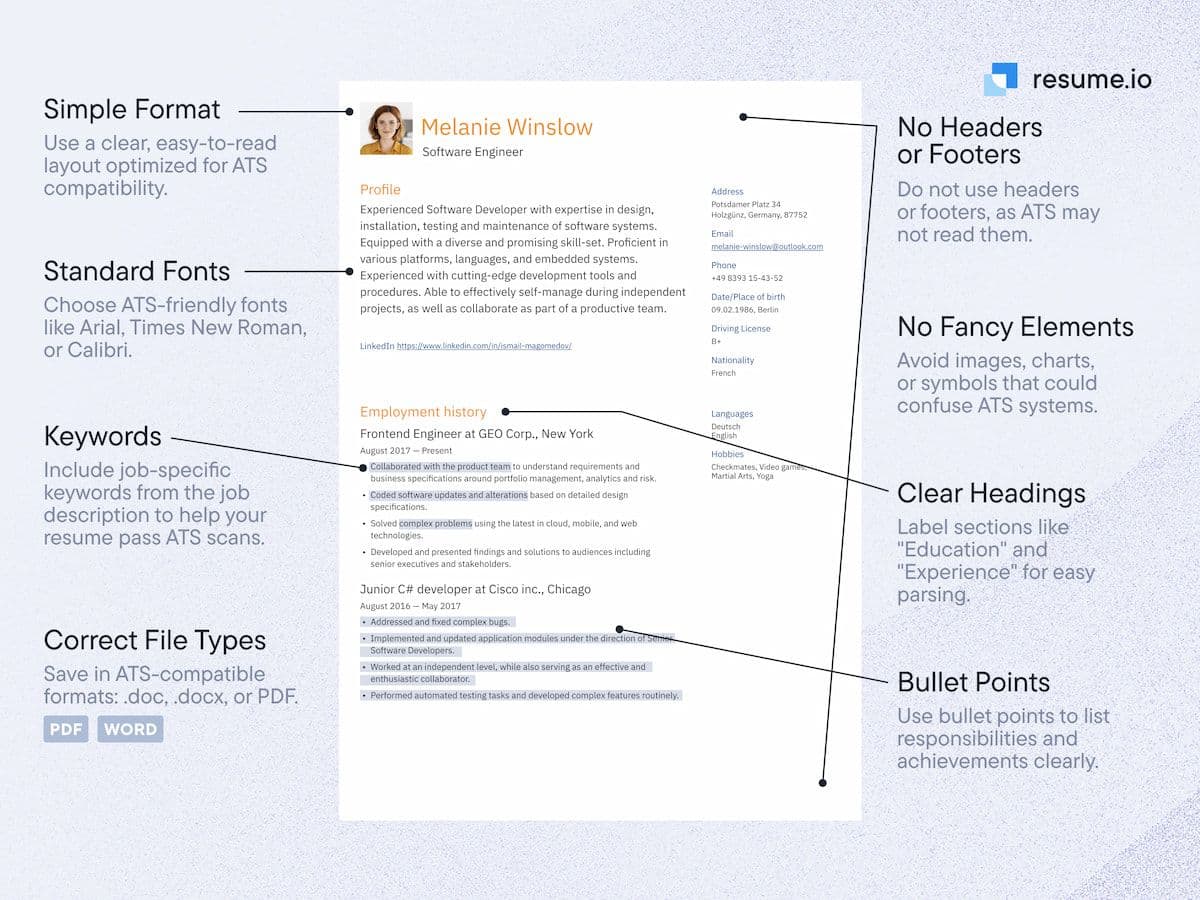
Most Canva templates are too visual for online applications. Multi-column layouts, icons, skill bars, and decorative graphics cause 23% of parsing failures, and image-heavy templates can lose more than half their content during ATS scanning (ResumeAdapter, 2025). If you want to use Canva, pick a plain one-column layout with no photo, no icons, and no skill bars. For most first-time job seekers, Google Docs or Microsoft Word with a basic template is safer.
The appeal of Canva is understandable. It looks like the design effort is doing work for you. But online applications go through parsers before they reach a human, and the parser doesn't see your design. It sees text strings. If those strings are split across columns, embedded in images, or laid out in tables, the parser either skips them or scrambles them.
Safer template sources, all free:
- Harvard Bullet-Point Resume Template: clean structure for a first draft.
- Harvard Guide to Creating a Strong Resume: framing principles.
- MIT Sample Resumes: beginner and student examples across experience levels.
- MIT Resume Guidance: formatting rules and one-page guidance.
- Microsoft ATS-Friendly Resume Templates: downloadable Word templates safer than heavily designed alternatives.
- CareerOneStop Resume Guide: free US government resource for job seekers.
- Harvard Guide on Listing Certifications: where to place ServSafe, food handler certificates, CPR, Google certificates, and similar credentials.
These resources are free, ATS-friendly by default, and come from career services or government sources. None of them try to upsell you a "premium template."
Should You Use AI to Write Your First Resume?
Use AI to rewrite real experience into stronger bullets, not to invent experience. AI is useful for compressing "I helped take care of kids on Saturdays" into "Supervised two children after school, managing meals, homework, and safe activities." It's dangerous when used to fabricate jobs, exaggerate responsibilities, or claim skills you don't actually have. The median first-submission ATS score is 48 out of 100 (ResumeAdapter, 2025), and AI rewriting can lift that score honestly. It can also tank it by adding generic phrases interviewers learn to discount.
A useful prompt:
I am applying for [job title]. I have no formal work experience, but I
have done [babysitting / cleaning / school project / certification /
volunteer work]. Rewrite these into honest, entry-level resume bullets
using simple language and action verbs. Do not exaggerate or invent
details.
Why this prompt works. It gives the AI three specific constraints: honesty, simplicity, no fabrication. The output is usable as a first pass, but you should still edit it before submitting. AI-generated bullets often default to generic adjectives like "results-driven," "hardworking team player," or "self-starter" that signal a script. Strip those. Replace them with specifics. For the broader AI-in-job-search context, see our analysis of why AI job application tools can hurt your search.

What Not to Include on a Beginner Resume
Cut anything that creates parsing errors, signals inexperience, or adds noise. The do-not list is short and consistent across nearly every career services source.
- No photo. Especially for US applications. Creates bias concerns. Can confuse ATS parsing.
- No birthdate. Same reasoning. Not standard in US hiring.
- No full home address. City + state is enough. Privacy and parsing both improve.
- No first-person paragraphs. No "I am a hardworking person who..." Bullets use action verbs, not pronouns.
- No "references available upon request." Recruiters will ask if they want them. The line wastes a high-attention slot.
- No fake experience. Reference checks happen. Fabricated jobs end the hiring process.
- No exaggerated skills. "Expert in Excel" doesn't survive a screening question.
- No multi-column design for online applications. Parser-killer.
- No tiny fonts to cram in more text. Better to cut content than to compress it.
- No irrelevant hobbies unless they support the role. "I enjoy crochet" doesn't help unless you're applying to a craft store.
The pattern across all of these. Each one is either a parsing risk or a signal that the candidate doesn't yet understand what a 2026 resume is supposed to do. The fix is removal, not replacement. For the parallel anti-template thesis on cover letters, see our guide to cover letter examples that get interviews.
How Do You Tailor a Resume for Each Job?
For each role, identify the 5 to 7 repeated skills or requirements in the job description, then adjust your Summary and Skills sections to honestly reflect the ones you have. A 10-minute pass per application is enough. You're not rewriting the resume. You're surfacing the parts of it that match this specific role.
The process:
- Read the job description twice. Highlight any phrase that appears more than once.
- List the top 5 to 7 repeated skills or requirements. These are the keywords the recruiter (and the ATS) will scan for.
- Match your real skills to the top requirements. Don't invent. Surface the ones you have but haven't emphasized.
- Edit your Summary section. Two to three lines, naming the role, your strongest matching skills, and one certification or credential.
- Edit your Skills section. Move the role-matching skills to the top of the list.
- Leave Experience and Education alone. Those don't change per application.
A pattern worth knowing. First-time job seekers who pair a simple one-column resume with direct career-page applications report higher callback rates than candidates submitting flashy templates through mass-apply tools. In the 400-to-600 applicant pool that entry-level postings attract, the resume that's easy to parse and the application that arrives early both contribute. The simple resume gets read. The early application gets read first. Reactive mass applying through aggregator boards loses both edges.
The tailoring is honest tailoring, not invented qualifications. If the job description asks for cash handling and you've done it informally, name it. If it asks for graphic design and you haven't, don't add it. Recruiters can tell. So can ATS keyword scoring when it's applied as a check rather than as a filter.
The Bottom Line
Simple beats flashy. A one-column, one-page, plain-text resume parses 94% of the time and reads cleanly to humans in the 17 to 46 seconds they actually spend on it. A multi-column Canva template loses half its content before anyone sees it. The instinct to compensate for thin experience with visual complexity is the instinct that gets your resume filtered.
Informal experience counts when framed honestly. Babysitting, cleaning, tutoring, school projects, certifications, and volunteer work all translate into resume bullets with the action + task + outcome formula. Use AI to compress real experience into stronger bullets. Don't use it to invent jobs or inflate skills.
Once the resume is solid, the next problem is reaching openings before the 400-applicant pool fills. Direct career-page monitoring (via tools like jobstrack.io) gives first-time job seekers a timing edge that the simple-resume + early-application combo amplifies. For the discovery side of the workflow, see our guide to the best job boards in 2026. After the resume gets you a screen, the 1-hour, 3-hour, and 24-hour interview prep plan and the 9 most common job interview questions carry the conversation forward.
Related Reading
Resume and Application Toolkit
- Resume Keywords and ATS Optimization: Complete Guide (coming soon)
- Why AI Apply Tools Hurt Your Job Search
- Cover Letter Examples That Actually Get Interviews (2026)
Interview Prep Toolkit
- How to Prepare for a Job Interview in Less Time (2026 Guide)
- Common Job Interview Questions: 9 Answers for 2026
- 30 Smart Interview Questions to Ask an Employer in 2026
- How to Write a Thank You Email After an Interview (2026)
- How to Follow Up on a Job Application (2026)
Job Search Strategy
- Best Job Boards in 2026 (And Why Direct Applying Still Wins)
- How to Humanize Your Job Application (And Get a Response)
References
Career Services and Authority Sources
- Harvard Career Services: Creating a Strong Resume: canonical resume framing.
- Harvard Career Services: Bullet-Point Resume Template: first-draft bullet structure.
- Harvard Career Services: Listing Certifications: where to place certifications.
- MIT CAPD: Sample Resumes: student and beginner examples.
- MIT CAPD: Resume Guidance: formatting rules, one-page guidance.
- Microsoft: ATS-Friendly Resume Templates: free Word templates safer than heavily designed alternatives.
- CareerOneStop: Resume Guide: US government job seeker resource.
Hiring and ATS Data Surveys
- ResumeAdapter: ATS Statistics 2026: 94% single-column parse rate, 23% failure rate from tables/columns, 92% of recruiters don't configure auto-rejection, median 48/100 first-submission ATS score.
- Enhancv: 170+ Resume Statistics for 2026: 17-46 second recruiter scan, top third gets 80% attention.
- HiroCV: 50+ Resume Statistics for 2026: 400-600 applications per entry-level posting, 1,000+ for customer service and remote roles.
- BestJobSearchApps: Best Resume Formats for 2026: ATS-friendly format guidance.
Image Credits
- Jessica Lewis Creative on Pexels: used as the hero image.
- Ron Lach on Pexels: used in the resume format section.
- Resume.io ATS resume templates: ATS-friendly resume template example used in the Canva and template section.
Community Source
- Reddit r/jobsearchhacks: Good resume templates for someone with no job experience: community source thread.
More Articles
Jobright Review 2026: Pricing, Pros & Cons
Jobright or Jobstrack.io? Compare job alerts, resume tools, application help, and pricing to choose the right fit for your job search.
Oct 15, 2026
Is Jobstrack.io Legit? How It Works, What It Costs, and What to Expect
See how Jobstrack.io job alerts work, what they cost, whether the trial needs a card, and how to judge the service before subscribing. Written by our team.
Oct 10, 2026
Auto-Apply vs Job Alerts: Which Actually Gets Interviews?
Compare auto-apply tools and job alerts on cost, control, and timing. See how Jobstrack.io helps you find matching roles directly on company career pages.
Sep 17, 2026